Hepper is reader-supported. When you buy via links on our site, we may earn an affiliate commission at no cost to you. Learn more.
Laser Treatment For Dog Arthritis - Does It Really Work (Our Vet Answers)

If your previously happy and active dog appears stiff, struggles to rise, and has trouble walking, he may be suffering from a debilitating condition known as osteoarthritis (OA). It’s estimated that twenty percent of dogs will develop OA1 in their lifetime making it the most common cause of chronic pain in our canine companions.
While there are a number of ways to manage canine arthritis including medication, diet, supplements, weight management, and physical therapy, laser therapy is gaining popularity as an alternative treatment as it’s painless, non-invasive, and drug-free. Laser therapy is reported to stimulate healing, reduce inflammation, and relieve pain caused by OA by using lightwaves of a specific frequency.
The use of laser therapy to treat canine arthritis certainly sounds promising, but the question is, does it really work? And if it does, how exactly does it work? Let’s explore the topic in more detail.

What Type Of Laser Is Used To Treat Arthritis In Dogs?
The type of laser used in veterinary medicine to treat the pain and inflammation caused by arthritis is known as a cold therapy laser. This type of therapy is also referred to as low-level light therapy or photobiomodulation.
Therapeutic lasers differ from surgical lasers in the sense that it used low levels of energy that do not cut or heat tissue.

Does Laser Therapy Really Work?
Although the use of laser therapy is relatively new in veterinary medicine, it’s been used for decades in human medicine to successfully treat a number of conditions.
Laser therapy is proving to be a safe and effective treatment for canine arthritis. Studies have shown that it can reduce pain levels2 and improve joint mobility in dogs with the disease.
After laser therapy owners may notice that their dogs are more active3 and that they start reengaging in activities that they enjoyed prior to developing arthritis. Dogs undergoing treatment may even require less pain medication as laser therapy starts to increase their comfort and mobility.
How Does Laser Therapy Work?
During a treatment, the laser is aimed at the affected area of the body sending lightwaves of a specific wavelength into the tissue. The lightwaves trigger chemical changes within the cells which promote growth and healing.
Laser therapy helps to treat arthritis by causing the following:
- Decreased pain though the release of endorphins, the body’s natural pain killers
- Reduced swelling
- Increased joint mobility
- Increasing blood flow which brings in oxygen and cells involved in the healing process
- Muscle relaxation
- Decreased inflammation
- Faster healing and repair
FAQs on Laser Therapy for Arthritis in Dogs
What can I expect at my dog’s laser therapy treatment session?
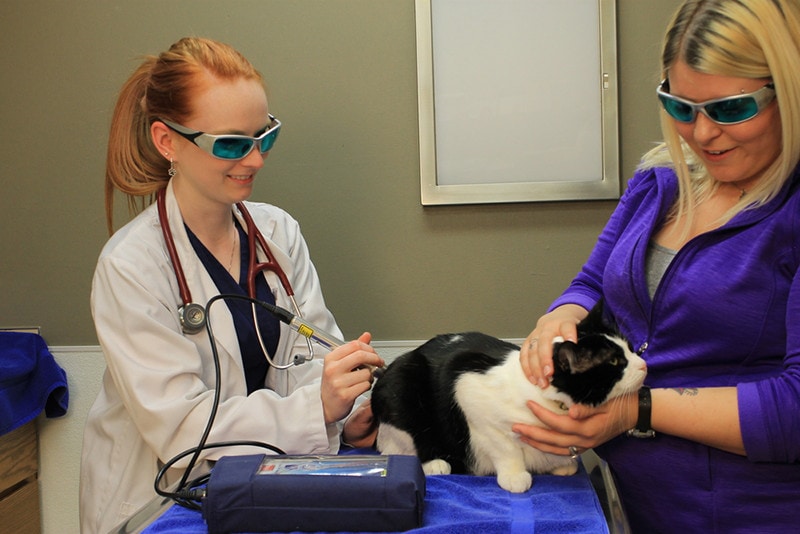
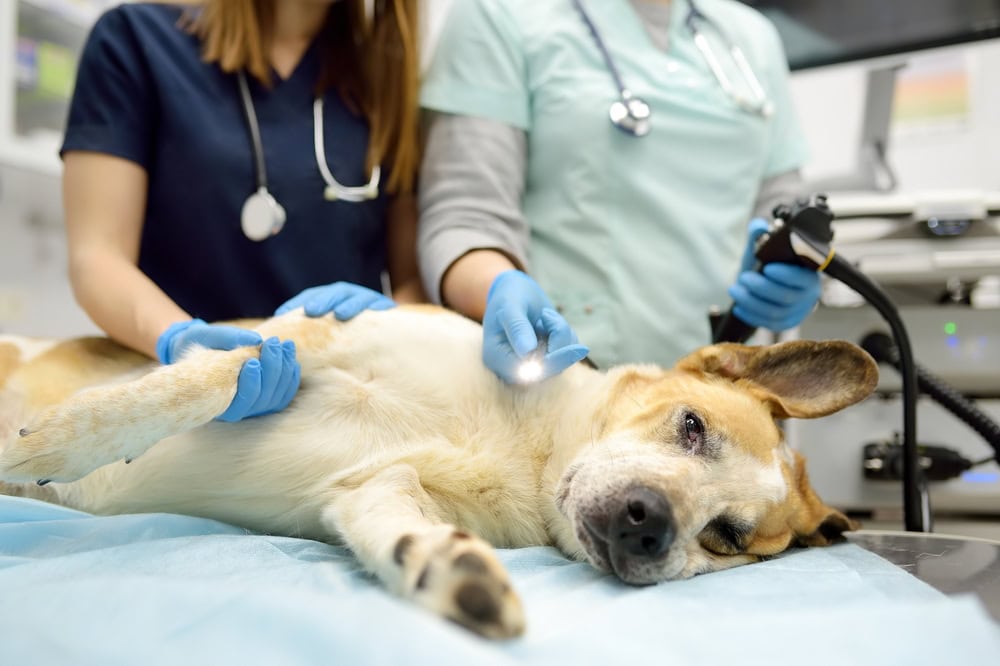
Laser therapy can be administered without sedation in the veterinary clinic while you hold your dog or while your dog lies on a soft mat on the floor. Most dogs do not need the hair clipped over the treatment area.
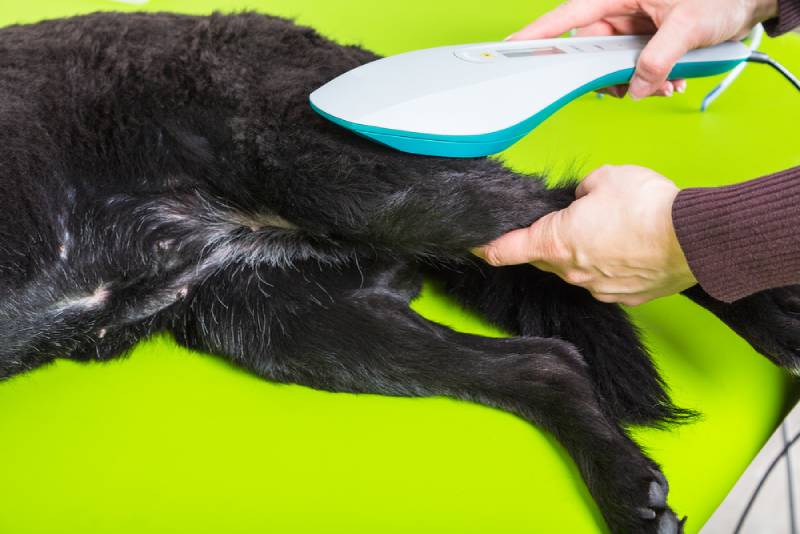
During a treatment session, a handheld probe is moved backwards and forwards over the arthritic joint, including the surrounding muscles and tendons. A treatment session typically lasts between ten to twenty minutes.
How many treatment sessions are needed to see an improvement?
The treatment plan for osteoarthritis involves three phases: induction, transition, and maintenance.
- Induction phase - During the induction phase, daily treatment is recommended until an improvement in symptoms is seen. It can take anywhere from two to eight weeks to see an improvement in pain and inflammation. Thereafter, the dog moves to the transition phase.
- Transition phase - During the transition phase, the treatment sessions are reduced to twice weekly for two to three weeks.
- Maintenance phase - During the maintenance phase, the treatment sessions are further reduced to a frequency that maintains the improvement achieved during the induction and transition phase. The frequency of treatments is based on the response of the individual dog, but are usually required every three to six weeks.
In general, 4 to 6 treatments are needed to see improvement, although 8 to 10 sessions may be needed for dogs with arthritis of multiple joints or those with severe disease.
Can laser therapy be used with other treatments for arthritis?
Therapeutic laser can be paired with other treatments for arthritis such as medication, supplements, nutrition, and physical therapy. This is known as a “multi-model” therapy plan. The treatment plan for a specific dog with OA will be determined by the veterinarian and tailored to that dog’s specific needs.
Is laser therapy safe?
Laser therapy is safe if performed correctly. It can also be used to control pain and inflammation when a patient with OA also has kidney or liver disease that prevents them from using prescription medicine like non-steroidal anti-inflammatories.
There are, however, certain instances when laser therapy shouldn’t be used.
These include:
Radiation from laser also has the potential to damage the eyes so it’s important that the patient, owners and veterinary staff in the treatment room wear protective goggles for the duration of the treatment.
Is laser therapy painful?
No, laser therapy is completely painless. Your dog will only feel warmth at the treatment site. Dogs tend to find treatments relaxing and enjoyable.
Can laser therapy be used to treat other conditions?
Yes, laser therapy can be used to treat a wide variety of conditions involving pain and inflammation including:
- Surgical incisions
- Tendon and ligament injuries
- Traumatic injuries
- Ear infections
- Intervertebral disc disease

Conclusion
For dogs struggling with the debilitating effects of osteoarthritis, laser therapy is proving to be an effective treatment. It’s painless, non-invasive, and drug-free and is able to stimulate healing, reduce inflammation, and relieve pain caused by OA by using lightwaves of a specific frequency. Laser therapy can be used on its own or may be used as part of a multi-modal pain management plan to treat arthritis.
Sources
https://stage.cliniciansbrief.com/article/treating-canine-osteoarthritis
https://caninearthritis.co.uk/what-is-arthritis/arthritis-the-basics/
https://avmajournals.avma.org/view/journals/ajvr/83/8/ajvr.22.03.0036.xml
https://www.aaha.org/your-pet/pet-owner-education/ask-aaha/laser-therapy/
https://vcahospitals.com/know-your-pet/multi-modal-pain-management
https://www.aaha.org/your-pet/pet-owner-education/ask-aaha/laser-therapy/
Featured Image Credit: msgrafixx, Shutterstock
Get Hepper In Your Inbox


Pet care tips from our vets and experts, straight to your inbox.
You may opt-out at any time. View our Privacy Policy for more information.
Lindsay is a veterinarian who lives in the beautiful city of Cape Town, South Africa with her husband and their rescue cat and dog, Harrison and Blizzard. Lindsay obtained her bachelor's degree in veterinary science from the University of Pretoria and currently works in small animal practice. When she’s not at work, you can find her out in nature, hiking with Blizzard, or following some kind of creative pursuit, such as writing, playing the piano or sewing.
Lindsay is a veterinarian living in Cape Town, South Africa with her husband and their rescue animals, Harrison and Blizzard. You can find her hiking with Blizzard, enjoying time in nature, or writing when she’s not working.
Education
Lindsay graduated from the University of Pretoria, receiving her bachelor's degree in veterinary science.
Experience
Lindsay currently works in small animal practice.
Join the conversation
Ask a question, share your story, or send private feedback.