Hepper is reader-supported. When you buy via links on our site, we may earn an affiliate commission at no cost to you. Learn more.
My Dog Ate a Balloon: Here’s What to Do (Vet Answer)

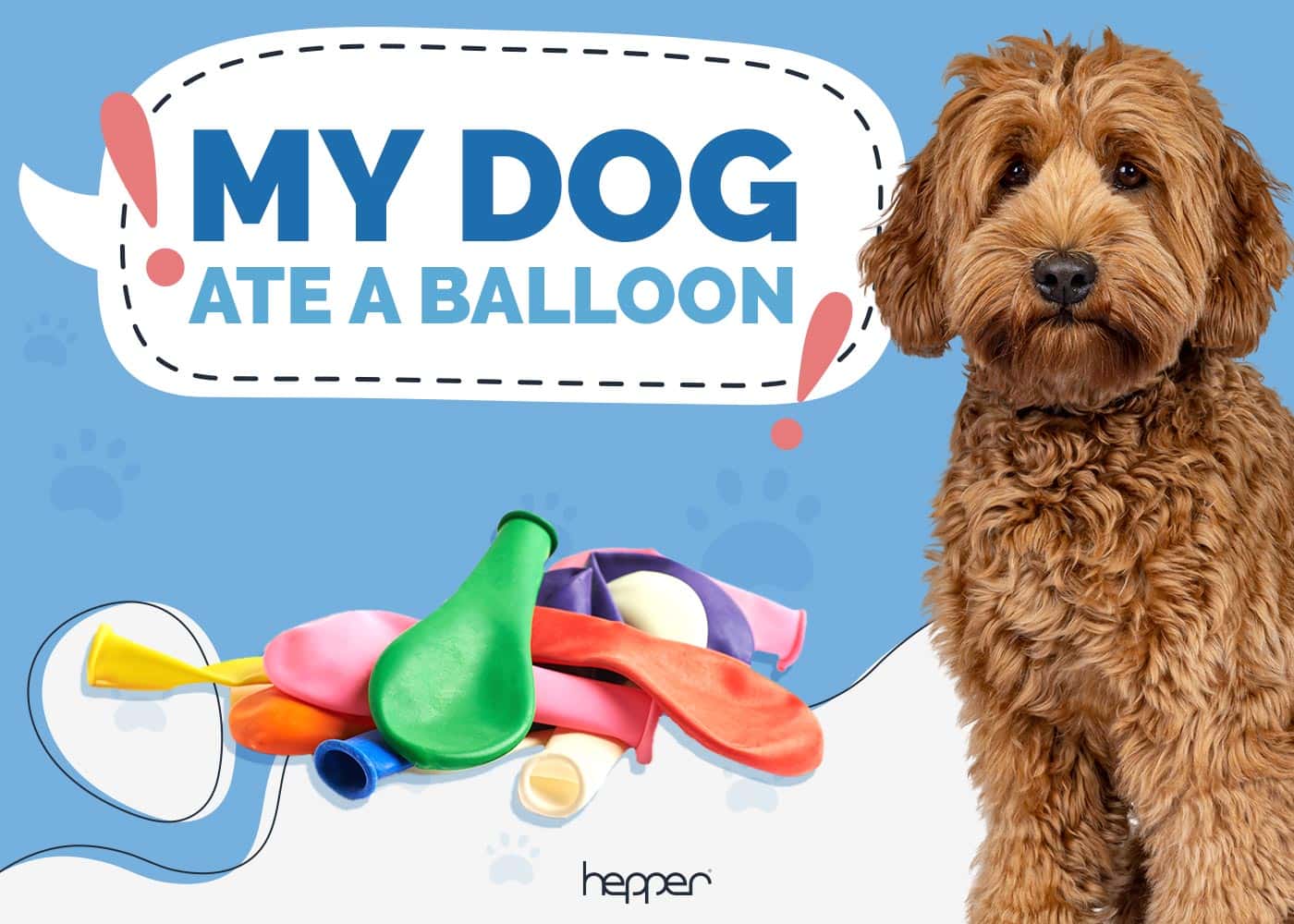
Dogs have been known to eat all kinds of strange things. It is hard to understand the appeal of non-food items like balloons, but if your pup has eaten one, they are certainly not the first! Maybe they were sniffing their way through the aftermath of a birthday party, and there were balloon remnants mixed in with some tasty crumbs.
Or maybe they were playing with what they thought was a particularly fun ball that popped upon capture and was then accidentally swallowed. Regardless of how it happened, if your dog just ate a balloon, it warrants an urgent chat with your veterinarian.
Balloons can easily become stuck in your pup’s throat or gastrointestinal (GI) tract, potentially causing a blockage. The situation is especially serious if the balloon is attached to a string.
Here is our step-by-step plan for what to do next (and what NOT to do!).

What to Do if Your Dog Has Eaten a Balloon
1. Contact Your Veterinarian
If your pup ate a balloon, please call your veterinarian immediately. If your regular clinic is closed, contact the local emergency clinic.
Balloons are usually made of a material like latex, which your pup’s digestive system cannot break down, so they can pose a risk for obstruction (blockage)—especially if your dog is small or ate more than one balloon.
Eating a balloon is particularly dangerous if it is attached to a string or ribbon, which can act as a linear foreign body:
- The balloon may become lodged somewhere like the pylorus (where food sits before exiting the stomach), while the string passes through into the small intestine
- The walls of the intestine contract, trying to pass the material, but instead, it bunches up along the string
- Vets often describe this as a “drawstring” effect
If you see string or ribbon hanging out of your dog’s mouth, please do not attempt to pull it out! Seek veterinary attention immediately.
If your veterinarian offers endoscopy, they may recommend putting your pup under a short general anesthetic to try and retrieve the balloon(s). An endoscope is a flexible, lighted tube that can be passed down the esophagus into the stomach. It has special attachments to grasp items and pull them out. If successful, endoscopy can help your dog avoid surgery!
2. Do Not Attempt to Induce Vomiting Unless Recommended by Your Veterinarian
In some cases, your veterinarian may decide that the best course of action is to try to get your pup to vomit up the balloon. This is most likely to be successful if attempted shortly after the balloon is eaten (i.e., while it is still in the stomach).
Induction of vomiting should be done in the clinic under veterinary supervision. The vet will give your pup medication, which should result in vomiting very quickly (often within a few minutes).
There are some risks associated with inducing vomiting, most notably that your pup could aspirate (breathe in) the vomited material. This could possibly lead to pneumonia. However, waiting to see if the balloon makes an appearance in your dog’s poop has its own set of risks.
Your vet will discuss the pros and cons of attempting to induce vomiting and help you decide if it is the best course of action for your particular pup.
3. Monitor Your Pup for Signs of Gastrointestinal (GI) Upset or Blockage
Your veterinarian may decide it is safe to try and let the balloon pass through on its own. If that is the case, they will ask you to monitor your pup closely for signs of gastrointestinal (GI) upset and, most importantly, obstruction (blockage).
Here’s what to watch for:
- Reduced appetite
- Drooling more than usual
- Vomiting
- Changes in bathroom habits (e.g., diarrhea, straining, blood in the poop)
- Low energy
- Signs of a sore abdomen (e.g., “downward dog” pose, tense or firm-feeling belly, not wanting their belly to be touched)
If you notice these signs or have any other concerns, please let your vet know immediately. They may recommend taking some radiographs of your pup to help determine if surgery is needed to remove the balloon.

In Conclusion
Balloons are a favorite decoration for many types of festivities, but they should always be kept out of reach of curious dogs. If you are hosting a party, it is probably best to keep your canine friend in a safe location away from the food and decorations. Be sure to clean up thoroughly afterward and, as fun as it might seem, never let your pup play with leftover balloons!
Featured Photo Credit: Africa Studio, Shutterstock
Get Hepper In Your Inbox


Pet care tips from our vets and experts, straight to your inbox.
You may opt-out at any time. View our Privacy Policy for more information.
Dr. Sharon (as she is known by her clients) has had an intense love for animals for as long as she can remember. She grew up in Guelph, Ontario and fulfilled her childhood dream by obtaining her Doctor of Veterinary Medicine (DVM) degree from the Ontario Veterinary College in 2009. She has since found joy working in a variety of small animal clinics, focusing on cat and dog care. She loves sharing her expertise and empowering pet owners to take the best possible care of their fur babies!
Sharon currently lives in beautiful British Columbia with her husband, daughter, and Parker, her loveable Great Dane. When she’s not at work, she enjoys clogging, photography, and exploring the outdoors with her family.
Dr. Sharon (as her clients call her), was raised in Guelph, Ontario, and has loved animals for as long as she can remember. She fulfilled her childhood dream when she obtained her Doctor of Veterinary Medicine (DVM) degree. Sharon now lives in British Columbia, Canada with her husband, daughter, and Parker, their loveable Great Dane. When she’s not working, she enjoys clogging, photography, hiking, and camping with her family.
Education
Dr. Sharon obtained her DVM in 2009 from the Ontario Veterinary College in Ontario, Canada.
Experience
Dr. Sharon loves sharing her knowledge and empowering people to take the best possible care of their fur babies, which she has been able to do through her work. She has practiced in a variety of small animal clinics since graduating, with a main focus on cats and dogs.
Check out some of our top posts written by our veterinary team:
Why Does My Dog Snore? Should I Act?
My Cat Ate Paint! Our Vet Explains What to Do Now
How Common is Heartworm in Cats? 7 Things to Know About Heartworm Disease
Join the conversation
Ask a question, share your story, or send private feedback.