Hepper is reader-supported. When you buy via links on our site, we may earn an affiliate commission at no cost to you. Learn more.
Toy Poodle Health Problems: 7 Vet-Approved Concerns to Look Out For


In this article
Toy Poodles are the small and sweet variants of the curly-coated, handsome breed. They are always delighted to sit in their owner's laps and are more than willing to play a good game of fetch. These loyal companions hail from one of the oldest known dog breeds, but while the Toy Poodle has plenty of positives, are there any health concerns Toy Poodle owners should look out for?
Read on to learn about seven health problems Toy Poodle owners should be concerned about.

The 7 Common Toy Poodle Health Problems
1. Patellar Luxation
Patellar luxation is the term veterinarians use to describe a dislocation of the kneecap out of its proper place. Patella luxation usually means the kneecap slips out sideways and can be uncomfortable and cause chronic joint problems for the dog if not treated.
While vets can fix a luxated patella with surgery, unfortunately, if the problem is not addressed early, the ligaments and joining tissues can be damaged, weakening the joint.
Signs and symptoms include:
- Limping
- A skip in the dog’s step
- Pain in walking
- Hesitation to sit up
2. Distichiasis & Entropion
Distichiasis is the growth of eyelashes pointing towards the eye. As you can imagine, this irritates the cornea (the eye's surface) and can be very painful, causing corneal damage and ulceration of the eye. Entropion is an inward rotation of the eyelid also causing eyelashes or facial hair to rub against the cornea.
Without treatment, both conditions can cause corneal ulcers and more severe eye problems; however, the condition is usually fixed with minor surgery when the Toy Poodle is young.
Signs and symptoms include:
- Weeping eye
- Redness in the eye
- Eye being held shut
3. Legg-Calve-Perthe’s Disease
Aseptic necrosis of the femoral head, also known as Legg-Calve-Perthe’s disease, is a degenerative condition of the hip joints, hypothesized to be due to reduced blood flow to the femoral head: the "ball" of a "ball and socket" joint. This causes the top of the thigh bone (femur) to become very brittle and easily break. It's an excruciating condition, usually discovered when the puppy is around 6 to 9 months.
Signs and symptoms include:
- Lameness
- Pain in affected hip
- Reluctance to weight bare
4. Tracheal Collapse
Tracheal collapse is a condition in which the trachea (the windpipe) in an animal's throat is weakened, as the rings of cartilage supporting it can no longer do so due to injury, congenital weakness, etc.
This weakness causes the trachea to collapse, potentially blocking the airways and making it hard for the affected animal to breathe while being very uncomfortable.
Signs and symptoms include:
- Coughing
- Vomiting or gagging due to coughing
- Wheezing
- Blue tongue or gums (cyanosis)
- Collapse
4. Cushing's Disease (Hyperadrenocorticism)
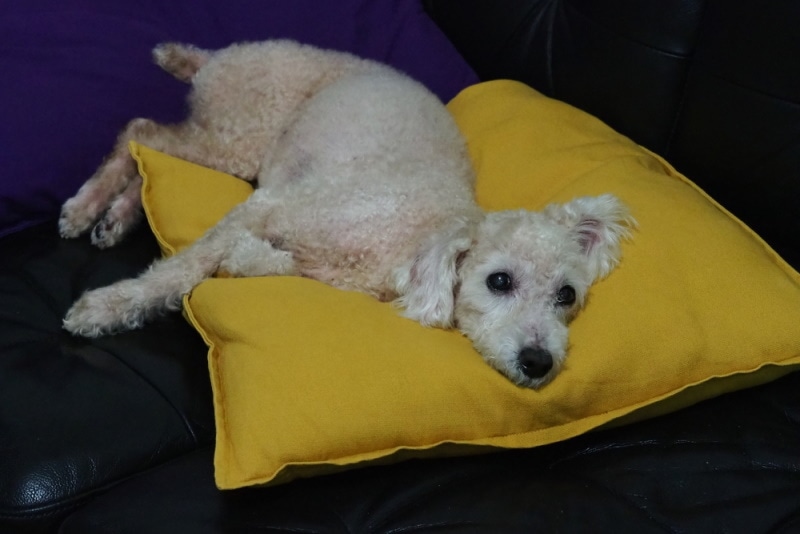
Cushing's disease is an endocrine disorder in which the adrenal glands, located on top of your dog's kidneys, produce too much cortisol, the stress hormone. This causes the body to change its metabolic processes, causing various health problems in dogs.
Cushing's is a slowly progressing disease that may not be immediately noticed. However, it may be detected earlier in Toy Poodles than in other breeds due to body changes.
Signs and symptoms include:
- Hair loss
- Poor coat quality
- Increased appetite
- Increased thirst
- Enlarged abdomen (potbelly)
5. Tumors
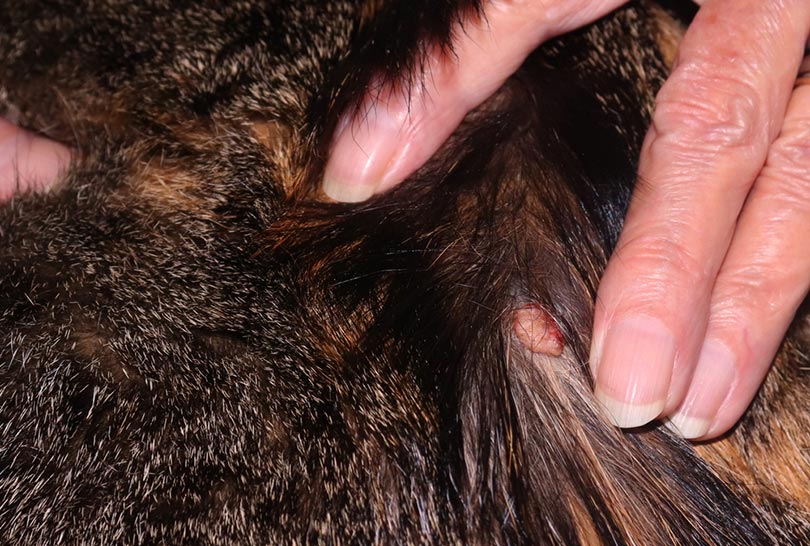
Toy Poodles are more prone to developing certain tumors. For example, mammary tumors, which can be benign (not dangerous) or malignant (dangerous), basal cell tumors, and oral melanomas. A veterinarian will assess the lump and decide the best course of action.
Tumors are usually removed as soon as they are noticed, but additional treatments might be necessary depending on the type and the severity of the abnormal growth.
Signs and symptoms include:
- Solid mass on the skin
- Red or raised lumps on other body parts
- Marks or blemishes on the skin that change color or shape
6. Bladder Stones
Bladder stones are also a common health problem that Toy Poodle owners should look out for, as they can be very serious (not to mention painful) if left untreated. Bladder stones are caused by a build-up of certain minerals in the urine, the most common being struvite (magnesium ammonium phosphate) and calcium oxalate. Minerals may first form crystals, then bigger stones in the urinary tract.
These irritate the bladder walls and can even cause the urethra to become blocked, which can be fatal if not treated urgently.
Signs and symptoms include:
- Straining to urinate
- Passing only very little urine
- Not passing urine at all
- Blood in the urine
- Pain
- Licking their genitals
7. Epilepsy
Epilepsy is a neurological condition that causes a dog to have seizures, sometimes daily or weekly. Your Toy Poodle will probably receive oral medication to keep seizures under control. Sometimes the episodes can last longer than usual, known as status epilepticus.
If your Toy Poodle has a seizure, speak to your vet immediately. You don’t know if there have been other unwitnessed episodes! The cause of epilepsy in Poodles can be various and your vet will recommend specific tests to find it out. On occasions, the diagnosis may be idiopathic, which means no other reason has been found.
Are Toy Poodles Easy to Look After?
Toy Poodles are no more challenging to look after than other dogs of the same size and may be easier to care for than other toy breeds, as they're generally less highly strung.
Toy Poodles are intelligent and easy to train. However, this also means they are prone to boredom and will act out if they don't get enough attention. They also have relatively long lives for a dog, with the average lifespan for a Toy Poodle being 12—18 years. They need daily grooming due to their tightly coiled coats, but the upside to these curls is that the dogs are known not to shed much hair.
Final Thoughts
The Toy Poodle is an incredible dog and would suit those who want the intelligence, tenacity, and grace of a Poodle without having the space requirements for a standard size. Toy Poodles are predisposed to some health conditions owners should be aware of, and knowing their signs is a good way to be vigilant and look out for them.
Some genetic conditions can be screened for, so puppies and their parents should all be tested for any genetic diseases to avoid passing these illnesses to their offspring.
See Also:
Sources
https://www.pedigree.com/article/toy-poodles-5-biggest-health-risks
https://www.petmd.com/dog/conditions/urinary/c_dg_urolithiasis_struvite
https://www.petmd.com/dog/conditions/musculoskeletal/c_multi_patellar_luxation
https://www.fda.gov/consumers/consumer-updates/treating-cushings-disease-dogs
https://www.akcchf.org/research/research-portfolio/0018.html
Featured Image Credit: Servando Juvera, Shutterstock
Get Hepper In Your Inbox


Pet care tips from our vets and experts, straight to your inbox.
You may opt-out at any time. View our Privacy Policy for more information.
Oliver (Ollie) Jones is a zoologist turned freelance animal writer living in South Australia with his partner Alex and their mini zoo consisting of many aquatic creatures, dog Pepper, and of course, cat Steve. Ollie is originally from the USA and holds a Master's degree in wildlife biology. He hopes to share his feline knowledge and expertise with people so they can share in his passion and help their cats live their best lives.
Join the conversation
Ask a question, share your story, or send private feedback.