Hepper blog

Search our database of over 9,984 posts with up-to-date information from our experts and veterinarians.

Hepper is reader-supported. When you buy via links on our site, we may earn an affiliate commission at no cost to you. Learn more.

Do Cats Like the Dark? What Their Vision Tells Us

By Chelsie Fraser · Reviewed & fact-checked by Dr. Paola CuevasVet Approved
Dr. Paola Cuevas
Reviewed & Fact-Checked byDr. Paola CuevasMVZ (Veterinarian)
Paola Cuevas is a veterinarian and animal behaviorist, with over 18 years of experience working with a variety of species. Her passion is animal welfare and focuses on the importance of preventive medicine. Paola has skills in the fields of nutrition, microscopy, clinical pathology, diagnostic imaging, and endoscopy as well as extensive experience in animal training through positive reinforcement. As our in-house veterinarian, Paola is very happy to share her knowledge and experience with our readers and hopes to be helpful with any issue presented by your non-human family members.View authorThe information is current and up-to-date in accordance with the latest veterinarian research. Read about our vets
Share
Ask us a question in the comments
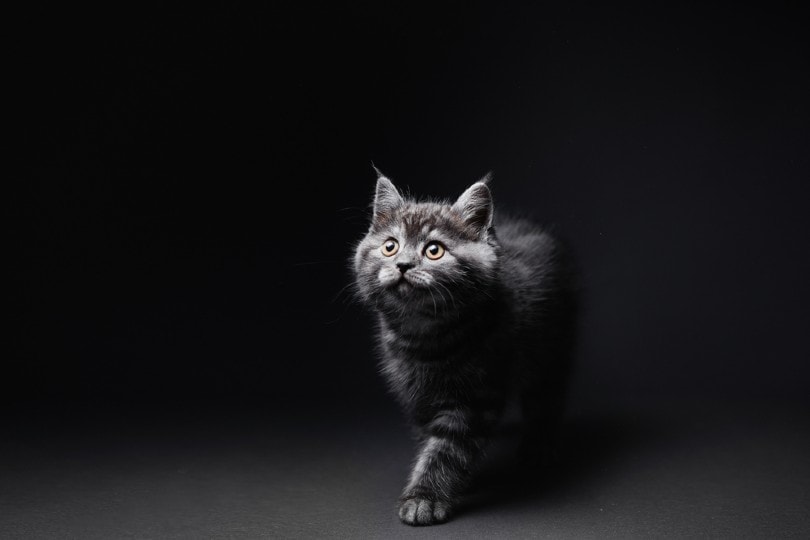
cat walking in the dark

Pop culture tells us that felines can see in the dark, but this simply isn’t true. Cats are crepuscular creatures, which means they’re most alert at sunrise and sunset. They prefer neither total darkness nor extreme brightness. Felines can sleep in both light and dark conditions, though, so it generally makes little difference if you leave the lights on or turn them off.

Myths About Cats and Darkness

It’s not uncommon to hear that cats are nocturnal, and any cat owner can tell you that their cats don’t mind being awake at night. Many will sleep all day and become more active in the evening and early morning hours. This perpetuates the myth that cats are nocturnal and that they can see in the dark.
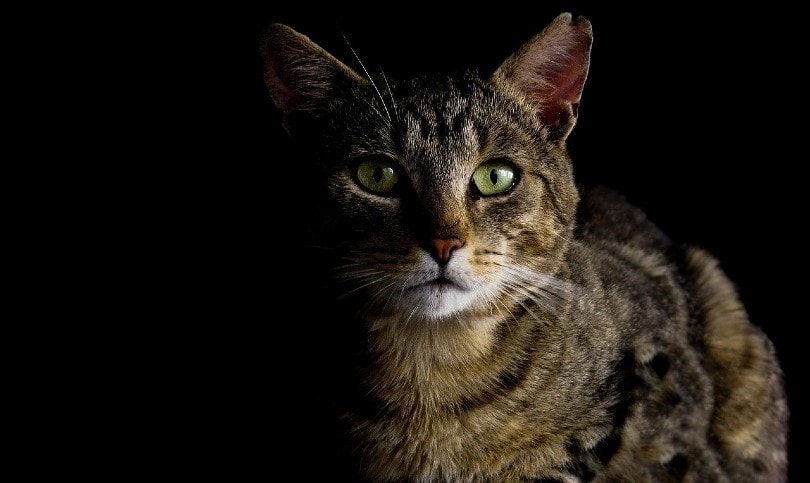
tabby cat in the dark
Image Credit: monicore, Pixabay

Eyeshine

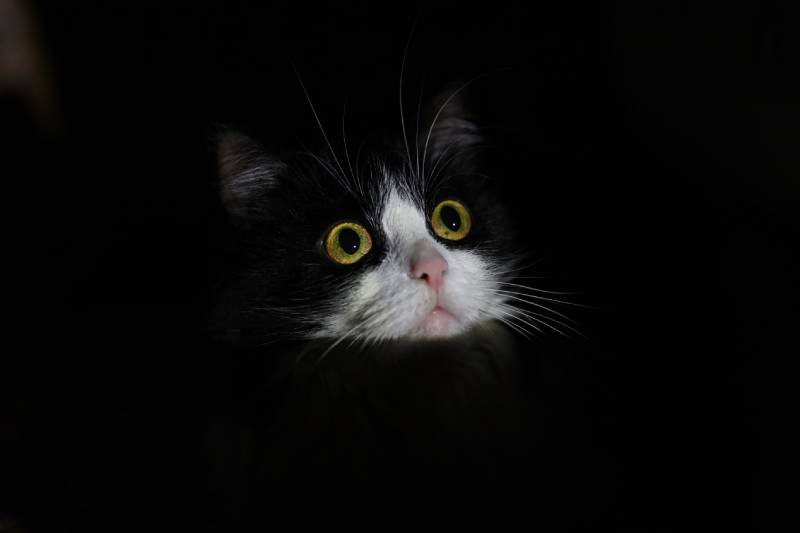
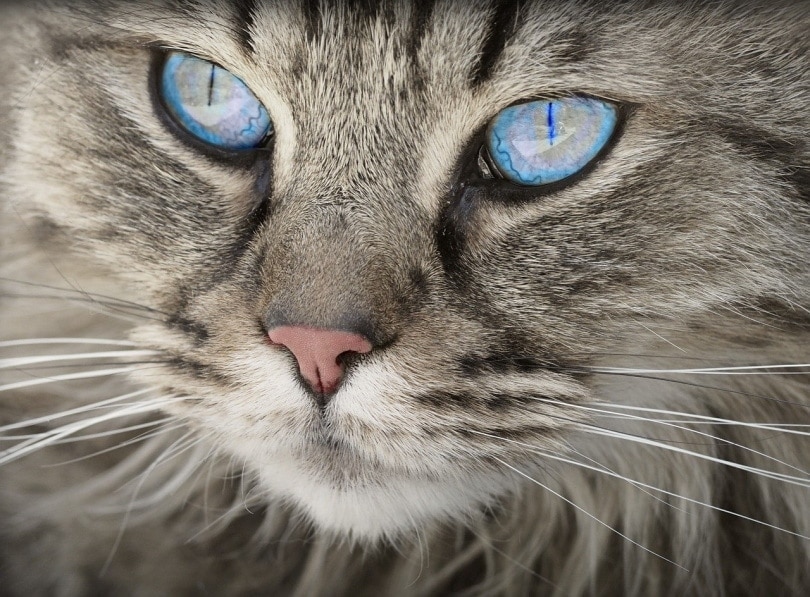
Cats’ eyes have something called “eyeshine.” Many animals have this feature, but it doesn’t help them see in the dark; it helps us see them. Animals with eyeshine reflect light with their eyeballs in a similar way to reflective lights or tape. We humans create these things to make ourselves visible in the dark. Cats have this feature built right in. The reflective structure responsible for eyeshine, called the tapetum lucidum, also helps improve vision in low-light conditions by reflecting light back through the retina.

Low-Light Vision

While cats can’t see in pitch-black darkness, they can see better in the dark than we can. They need only about 15% of the light volume that humans need to see clearly. This gives them superior low-light vision.

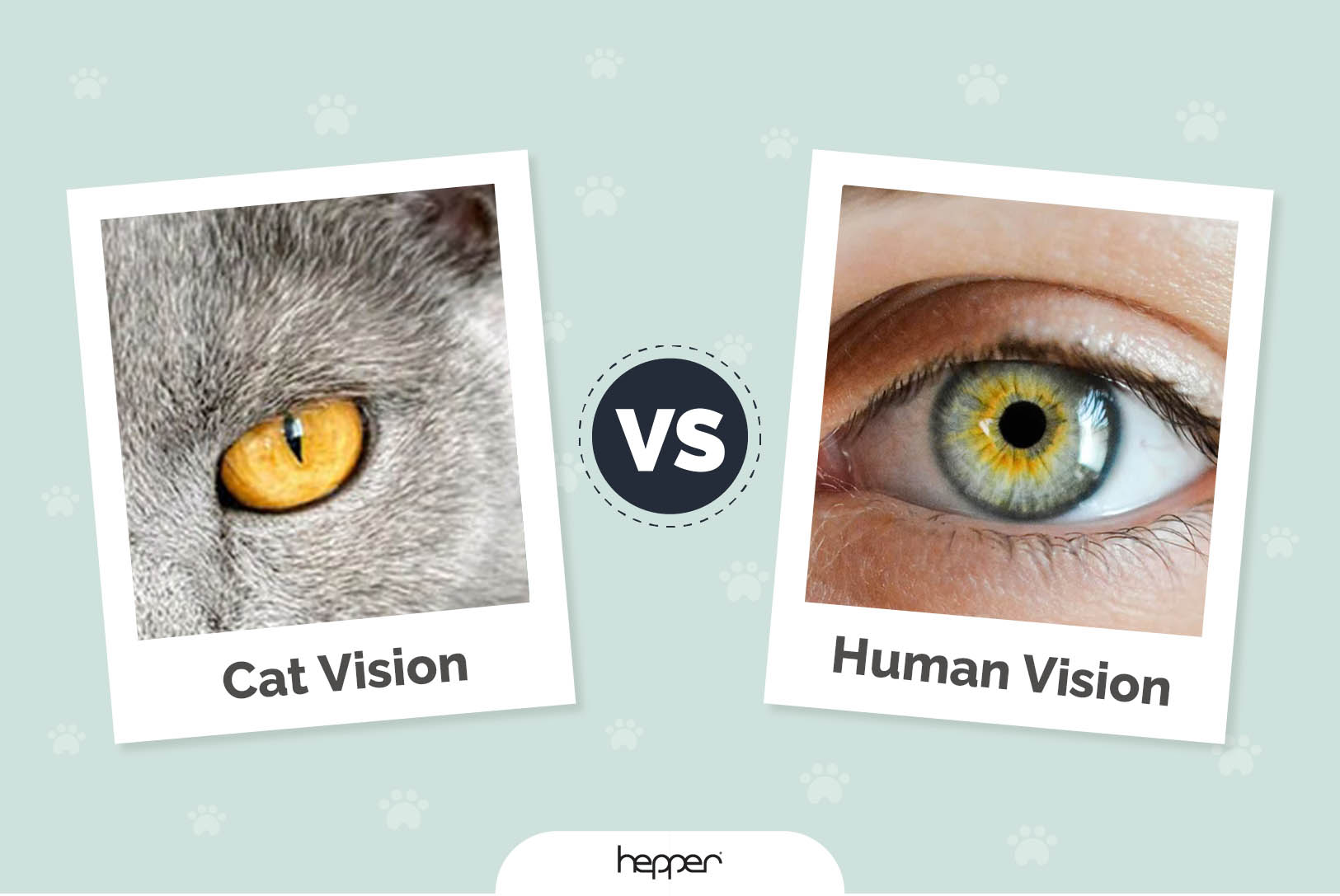
Cats have slit-shaped pupils that control the amount of light that enters their eyes. They can narrow to very small slits in bright light and widen considerably in dim light. We have round pupils that don’t provide us with these abilities.
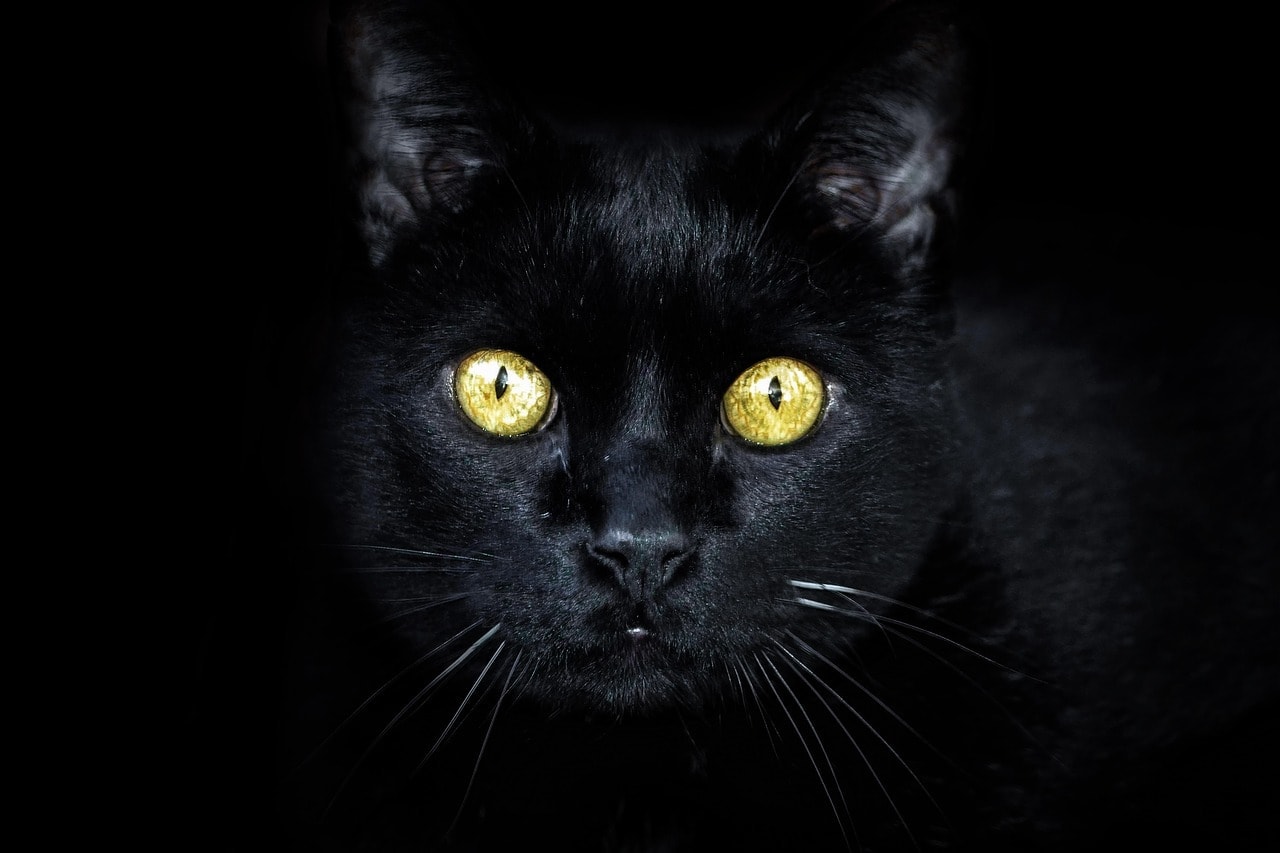
black cat with glowing eyes in the dark
Image Credit: Pixabay

Do Cats Have Good Vision?

Perfect human vision is defined as 20/20 vision. Cats have something ranging from 20/100 to 20/200 vision. This means that what we can see clearly from 100 feet, cats can only see clearly from 20 feet. They don’t have good near vision because they have a reduced ability to change the shape of their lenses compared with us humans.

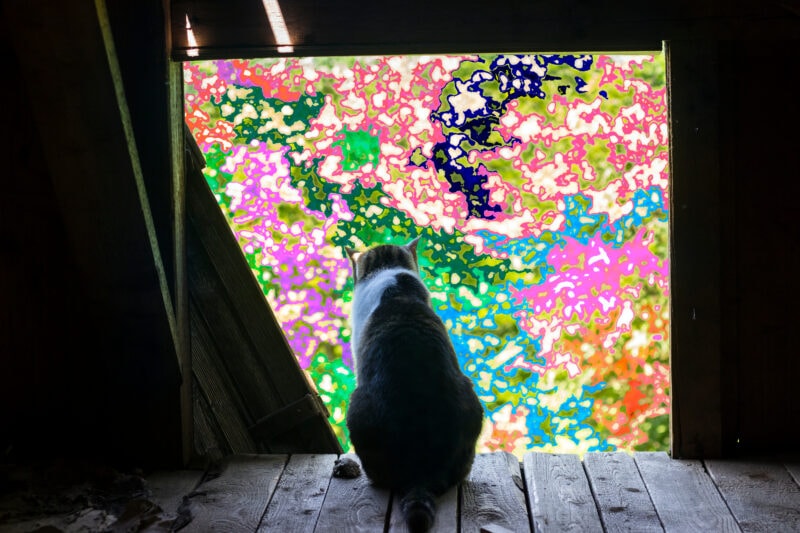
Humans also have better color vision, while cats have better night vision. Cats aren’t color blind per se, but humans can see more vibrant colors. The human eye has more cones, which are the cells responsible for seeing color. In place of those cones, cats have extra rods. Rod cells improve vision in low-light conditions. Cats are also better at detecting fast-motion objects than humans.

This is all to say that the term “good vision” is subjective. Cats have visual adaptations that help them function as predators, a skill that’s necessary for survival in the wild. Humans have vision that is adapted for different purposes.

What Light Spectra Can Cats See?

Cats can see a different spectrum of light than humans, including ultraviolet light, as determined in a university study conducted in London in 2014.

The electromagnetic spectrum contains all wavelengths of light known to exist. Visible light for humans ranges between 400 and 750 nm wavelengths. Anything measuring lower than 400 nm is considered ultraviolet light. These wavelengths are absorbed by our eyes and not “seen.”

Interestingly, cats are among the many animals known to have UV vision. Their eye lenses enable small amounts of UV light to pass through so it can be recognized by the brain. This allows cats to perceive some wavelengths of light that are not visible to humans.

Final Thoughts

Despite the perpetuating myth, cats can’t see in total darkness. They are not nocturnal, but they do prefer low-light conditions, like those at dawn and dusk. Their vision is specifically adapted for those situations. While cats can’t see color the way that humans do, they can see better at night and are better at detecting motion. Cats can also perceive some ultraviolet light that is invisible to humans.

See also:


Featured Image Credit: kudla, Shutterstock

Get Hepper In Your Inbox

Pet care tips from our vets and experts, straight to your inbox.

List

Select all that apply.

You may opt-out at any time. View our Privacy Policy for more information.

Chelsie Fraser
Authored by

Chelsie Fraser

Join the conversation

Ask a question, share your story, or send private feedback.

Rate this post
Required to post. Only our editors see your rating.
Who should see this?

A human reviews every comment before it appears. Your email is never published.

Picked to go with this article

Can Cats See in the Dark? Vet-Verified Feline Night Vision Facts

Can Cats See in the Dark? Vet-Verified Feline Night Vision Facts

Cats can see better than humans in some situations, but not all. However, the answer to how well cats can see in the dark is a bit more complicated than most p…

Kristin Hitchcock
By Kristin Hitchcock ·
How Do Cat Eyes Work? Vet-Reviewed Feline Physiology

How Do Cat Eyes Work? Vet-Reviewed Feline Physiology

Have you ever watched your cat chasing after a bug or climbing a cat tree and wondered how your kitty sees the world? Do our favorite felines see shapes and co…

Misty Layne
By Misty Layne ·
Cat Vision vs Human Vision: Comparisons & FAQ (With Infographic)

Cat Vision vs Human Vision: Comparisons & FAQ (With Infographic)

You may know that cats are active at night and have better vision than humans. But there’s plenty more that differentiates cat vision from human vision, such a…

Nicole Cosgrove
By Nicole Cosgrove ·
Are Cats Scared of the Dark? Vet Reviewed Facts & FAQ

Are Cats Scared of the Dark? Vet Reviewed Facts & FAQ

If your ordinarily brave feline is suddenly acting like a scaredy cat as soon as the sun goes down, you might wonder what’s going on. Is your cat truly fearful…

Elizabeth Gray
By Elizabeth Gray ·

Keep reading

More stories you might like

Do Cats See Color? Vet-Verified Facts & FAQ

We’re all familiar with the common misconception that dogs only see in black and white, but what about cats? Cats are apex predators, so it would only make sen…

Nicole Cosgrove
By Nicole Cosgrove ·
Do Cats See Color? Vet-Verified Facts & FAQ

Cat Vision vs Dog Vision: Who Has the Better Eyesight? (Vet-Reviewed)

Cats and dogs are known for their highly keen senses, such as smell and hearing, that are superior to those of humans. It would make sense that both of these a…

Sarah Psaradelis
By Sarah Psaradelis ·
Cat Vision vs Dog Vision: Who Has the Better Eyesight? (Vet-Reviewed)

Are Cats Color Blind? Feline Vision Explained (Vet Approved)

We’ve all pondered what the world looks like through a cat’s perspective, but have you ever thought about which colors your cat experiences the world in? And i…

Kerry-Ann Kerr
By Kerry-Ann Kerr ·
Are Cats Color Blind? Feline Vision Explained (Vet Approved)

How Do Cats Catch Mice at Night? The Science Behind the Answer

Cat owners that have been presented with prey by their feline friends will know that early morning is the time they are most likely to leave gifts. This is bec…

Nicole Cosgrove
By Nicole Cosgrove ·
How Do Cats Catch Mice at Night? The Science Behind the Answer

How Far Can Cats See? Vet-Reviewed Feline Vision Facts

As notorious hunters, cats are expected to have perfect vision. Their ability to spot mice scurrying around is impressive, as is their night vision. However, i…

Nicole Cosgrove
By Nicole Cosgrove ·
How Far Can Cats See? Vet-Reviewed Feline Vision Facts

Is My Cat Going Blind? 6 Vet-Verified Signs & Care Tips

Compared to humans, a cat’s sense of sight is unique. They can see much better in the dark than we can and detect even the slightest movement. Often, how easy…

Elizabeth Gray
By Elizabeth Gray ·
Is My Cat Going Blind? 6 Vet-Verified Signs & Care Tips

Is It True That Cats Protect From Ghosts & Spirits? The Myth Unveiled

Cats have a deep connection with the occult and all things mystical. There are stories about black cats and witches on broomsticks, but do cats have protective…

Nicole Cosgrove
By Nicole Cosgrove ·
Is It True That Cats Protect From Ghosts & Spirits? The Myth Unveiled

What Colors Do Cats Like? Why Do They Like Them? Vision Facts

Cats do not see all the colors we do, but they are not completely colorblind either. At the same time, cats have better sensitivity to light and motion, result…

Nicole Cosgrove
By Nicole Cosgrove ·
What Colors Do Cats Like? Why Do They Like Them? Vision Facts