Hepper is reader-supported. When you buy via links on our site, we may earn an affiliate commission at no cost to you. Learn more.
How Do Cats Catch Mice at Night? The Science Behind the Answer


In this article
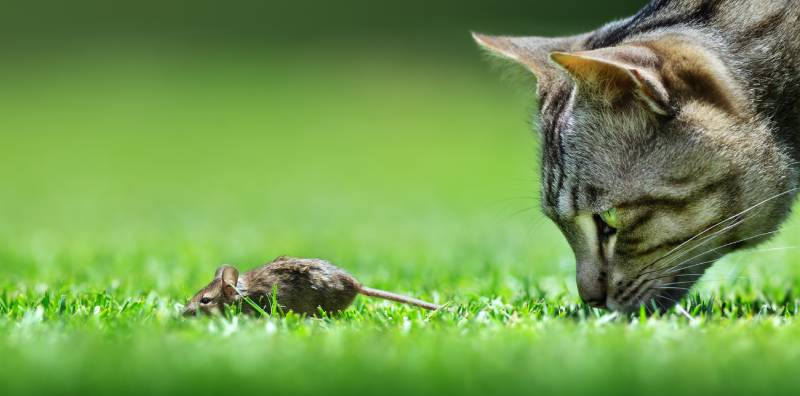
Cat owners that have been presented with prey by their feline friends will know that early morning is the time they are most likely to leave gifts. This is because cats are naturally well-equipped to hunt at dawn and dusk. They have an excellent sense of smell that first enables them to determine the location of mice and other rodents. They don’t have true night vision, but their eyes are designed to make the most of minimal amounts of light. Cats only need around one-sixth of the amount of light as humans to be able to see, and they can see well enough to identify and chase mice in very low light conditions.
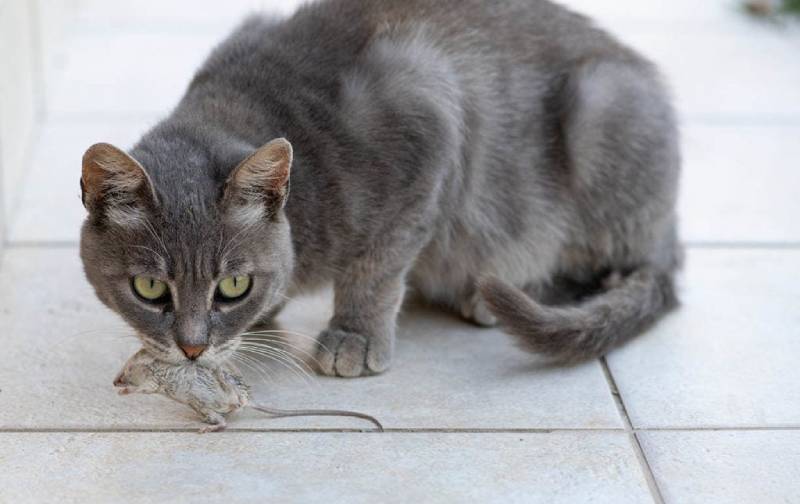
While house cats do not really need to hunt to survive, having food available for them almost whenever they want it, the hunting instinct is still present. Since cats are crepuscular and can see so well at dusk and dawn (this is the time when most rodents are active), this is why owners end up with one or more dead prey items on the doorstep in the morning.

Night Vision
Although cats don’t have true night vision, they are able to see extremely well in very low light conditions. They have corneas that are almost 50% larger than humans’ and pupils that become round and large when dilated. These allow more available light in and enable cats to see in lower light conditions than humans and a lot of other animals.
Cat eyes also have a structure called tapetum lucidum. This reflective layer works as a mirror reflecting light back into the retina, providing a second chance for the light to get absorbed by the photoreceptors. This tissue is also what causes the reflection of light that can make it appear as though your cat's eyes are lit up at night.
They also have different proportions of photoreceptors, which are the light-sensitive cells in the retina, responsible for converting light into electrical impulses that reach the brain to form images. Cats have more rods, whereas humans have more cones. Cones require a large amount of light to function and are responsible for detecting colors, hence why humans have richer color vision than cats. Rods, on the other hand, can work in poorly lit environments and are responsible for vision in darkness and motion detection.
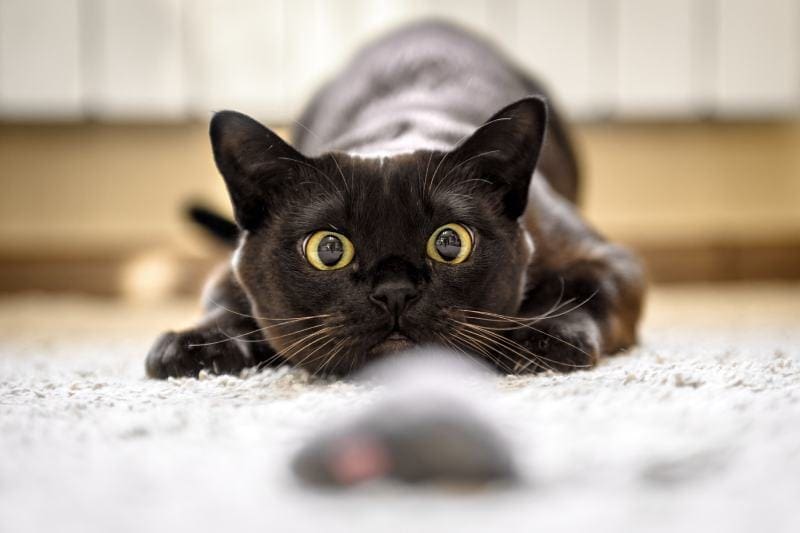
Finally, the pupils of a cat’s eyes can dilate from the thin black line that we typically see in the daytime and when the cat is in a relaxed state, to large black saucers. The dilated pupils enable more light to enter the eye.

Sense of Smell
A cat’s vision is just one of their senses and one way in which they are able to catch mice at night. During the early stages of predation, they rely primarily on their sense of smell. Cats have a highly tuned sense of smell that enables them to roughly locate mice that they can’t see. This is how cats can tell if mice are hiding in long grass or even in the walls of your home.
Why Cats Like Catching Mice
Cats are predators, and if they were in the wild, they would hunt for their food. They are strict carnivores, which means that their diet consists mainly of meat. Mice make ideal prey for cats because they are small enough to be easily caught and killed, and while a single mouse may not be a full meal, a skilled cat will catch and kill several mice in a single night.
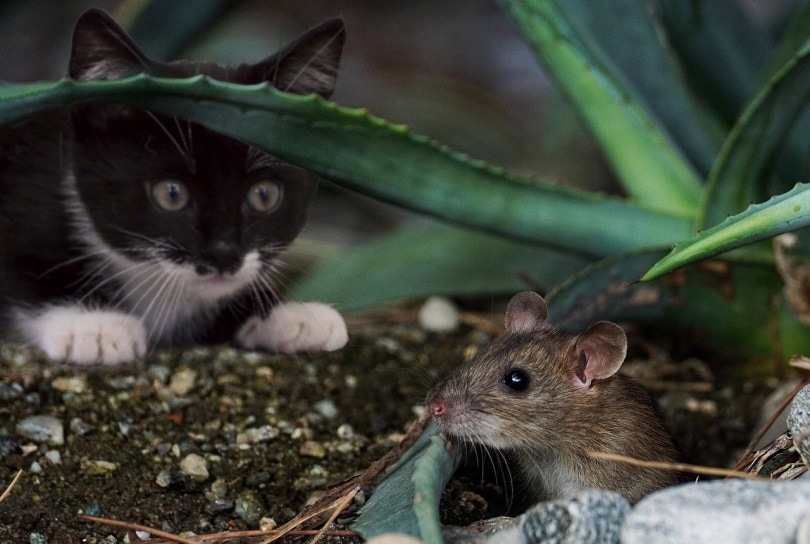
Domestic cats still have an innate desire to hunt, and even if they aren’t starving, their heightened motion-sensing vision means that they are attracted to the quick, darting movement of skittish mice. Once they see the movement, instinct drives them to catch the prey.

Will Mice Stay Away if You Have Cats?
Having cats can prevent mice from entering your home, although it isn’t a definite deterrent. Cats emit a chemical in their saliva that mice detect thanks to their vomeronasal organ, which provokes a fear response in them. Some mice may still enter the house, but the physical presence of your cat will probably keep them away. However, if your cat isn’t inclined to catch rodents, some mice may end up entering your home and leave you with a potential infestation. If that is the case, we recommend you contact a professional exterminator to discuss pet-friendly methods to eliminate rodents.
How Do I Stop My Cat From Bringing in Live Mice?
Cats bringing home dead prey can be a nuisance, but dead mice are a lot easier to deal with than live mice. Although there is no guaranteed method of preventing a cat from bringing in live prey, there are some steps that owners can take that might yield positive results.
Ensure your cat is well fed, although if they are bringing home live prey, it is unlikely that they are hunting to eat. Provide plenty of playtime with your feline friend. It might seem counterproductive, but providing toy mice means that your cat can play with them and it may control their desire to hunt.
Place a bell on the cat’s collar. Some owners claim that bells are ineffective, as cats can learn to control the motion of a single bell so that it is virtually silent. In that case, you can get a collar with two bells. If all else fails, you can lock the cat door at night to prevent your cat from going out and engaging in hunting activities.

Should you Let your Cat Hunt and Eat Mice?
Because chasing mice is instinctive for cats, it's easy to dismiss this activity as being natural and normal. If your cat goes outdoors, chances are they will hunt mice if they can, whether they bring them home or not. However, rodents can carry diseases that can put them and you at risk. Ideally, you should try and stop your cat from hunting mice and from bringing home gifts by using the methods above. Furthermore, the negative impact that free-ranging cats have on wildlife has been studied and should not be taken lightly.

Final Thoughts
In the wild, cats routinely hunt and eat mice, as well as other small prey, such as birds and reptiles. They are incredibly effective mice hunters thanks to their combination of a heightened sense of smell and vision that has developed to aid in the endeavor. While cats are unable to see in total darkness, our feline friends are able to see in very low levels of light, while also being better equipped to spot movement and to see this movement even at the very edge of their vision.
Featured Image Credit: 165106, Pixabay
Get Hepper In Your Inbox


Pet care tips from our vets and experts, straight to your inbox.
You may opt-out at any time. View our Privacy Policy for more information.
Nicole is a lover of animals of all sizes but is especially fascinated with the feline variety. She’s the proud mom of Baby, a Burmese, and works every day so he can relax in the sunshine or by the fire. She’s always had a cat in her home and has spent countless days with others, observing behaviors and softening up even the grouchiest of the lot. Nicole wants to share her kitty expertise with you so you and your cat can live happy, healthy, and care-free.
Join the conversation
Ask a question, share your story, or send private feedback.