Hepper is reader-supported. When you buy via links on our site, we may earn an affiliate commission at no cost to you. Learn more.
Cat Vision vs Human Vision: Comparisons & FAQ (With Infographic)
In this article
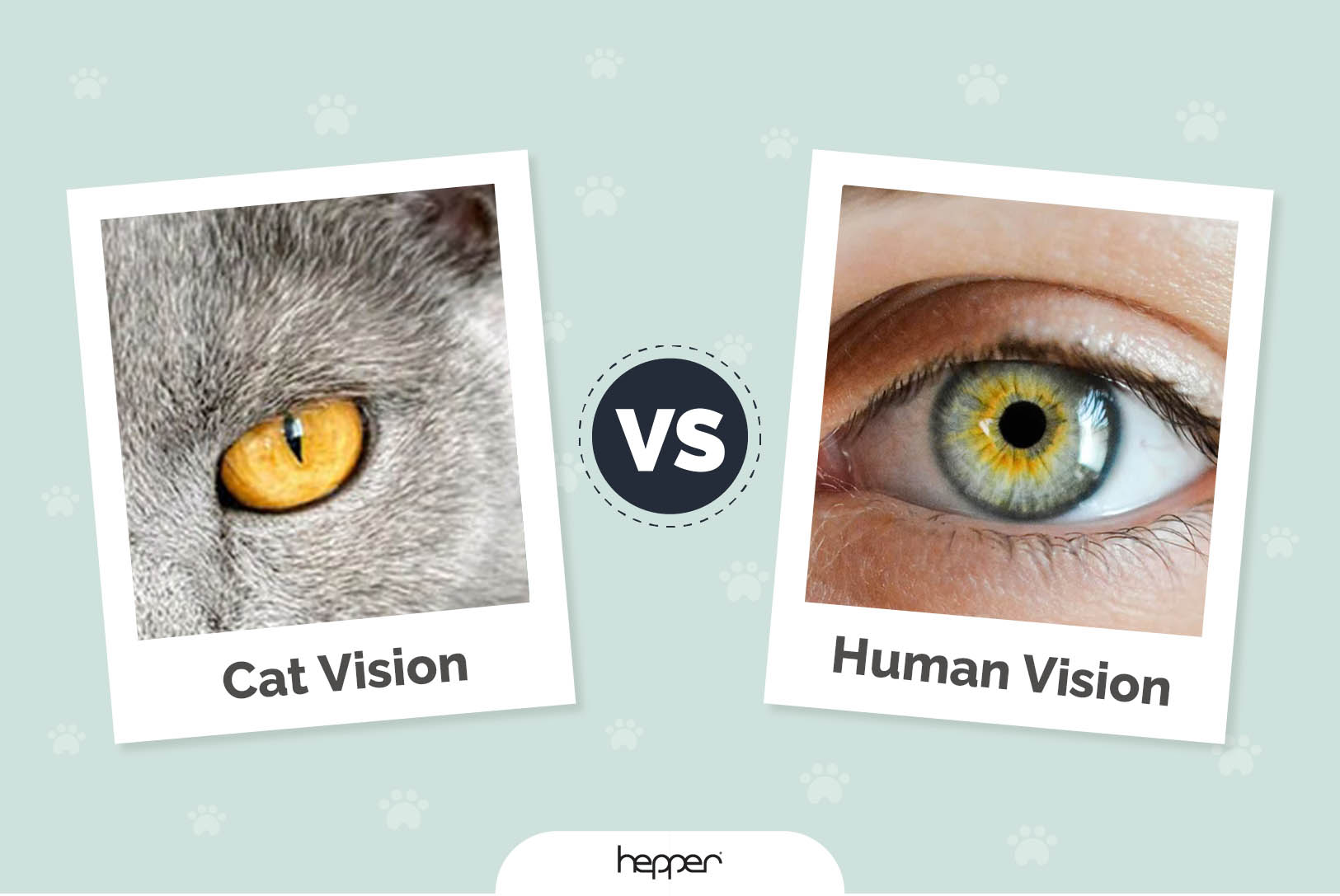
You may know that cats are active at night and have better vision than humans. But there’s plenty more that differentiates cat vision from human vision, such as the structures in the eye that help cats see and the way they interpret the world around them.
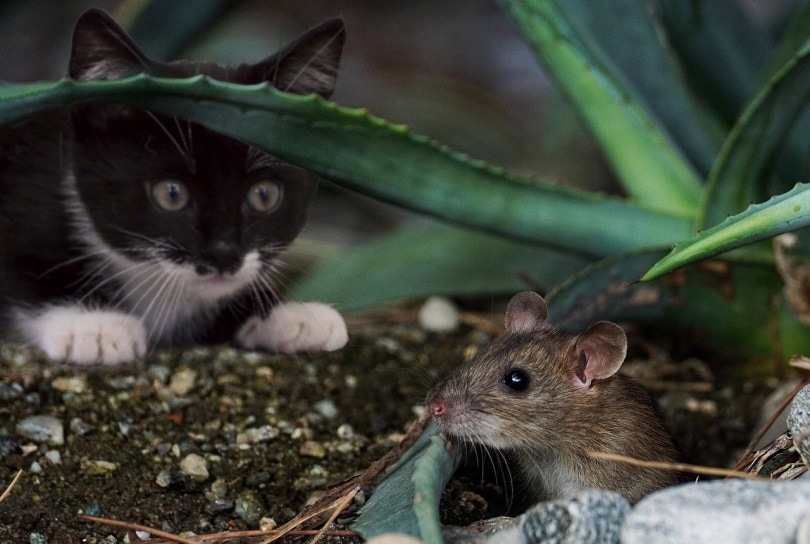
Cats also follow fast movement better than humans, which is expected for such adept hunters. But who’s vision is better? Do cats see more or different colors than humans? What about peripheral vision?
Read more about the differences between cat vision and human vision to understand how your four-legged friend perceives the world around them.

At a Glance
Overview of Cat Vision
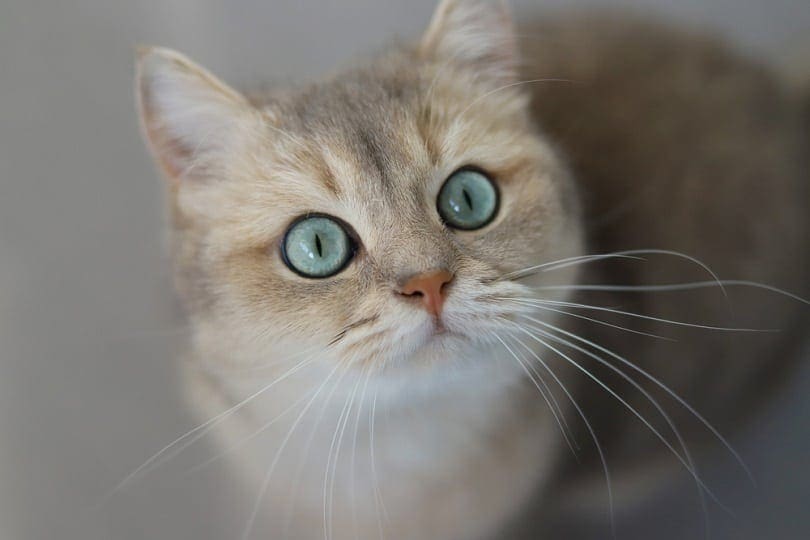
While we have no way to truly see the way cats do, we can extrapolate the differences in cat vision by understanding the structures of their eyes and how they translate to vision capabilities. Vision is a complex evolutionary capability that’s more than just what we see.
Cat Eye Structure
Cats’ eyes function a lot like humans, even if they have advantages and disadvantages. The eye adjusts to the amount of light to focus on objects near and far and produces images that are then relayed to the brain.
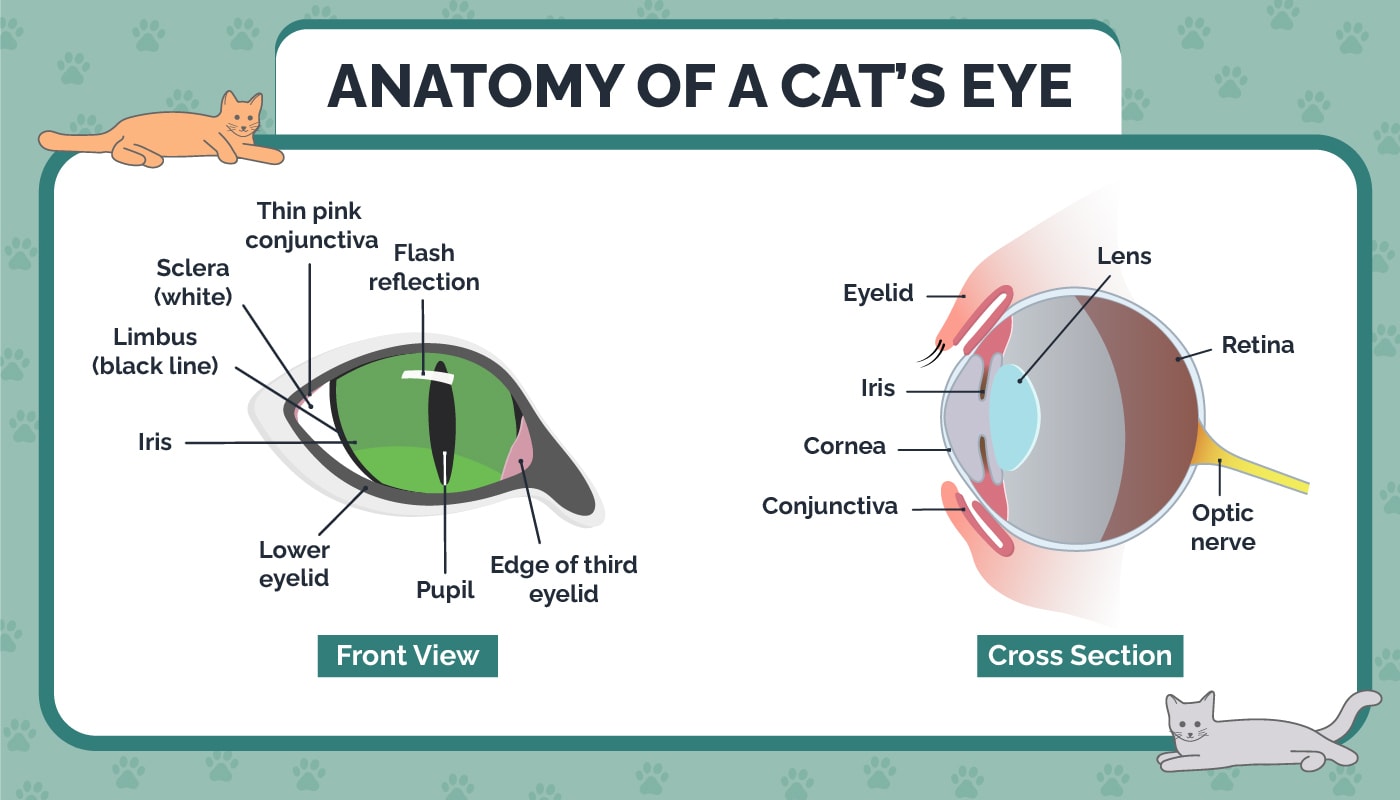
Cats have sclera, the white portion of the eye, and the conjunctiva, the thin membrane that covers the cornea, a clear dome on the front surface of the eye. Cats also have a colored iris and a pupil that dilates or contracts to let in more or less light.
The lens is located behind the iris and changes shape to focus light into the retina, which holds the photoreceptors. Cones and rods are the main photoreceptors, which interpret colors and low-light conditions, respectively.
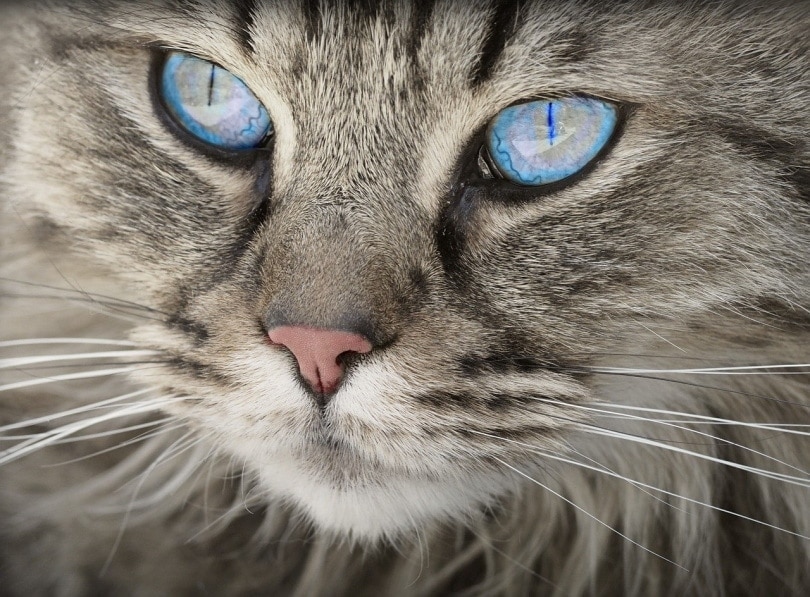
Cats also have a structure called the tapetum lucidum, which magnifies light and gives their eyes a blue or green reflection in the dark. The most sensitive area of the cat’s retina is the area centralis, which has thousands of photoreceptors to sharpen images.
What Are the Strengths of Cat Vision?
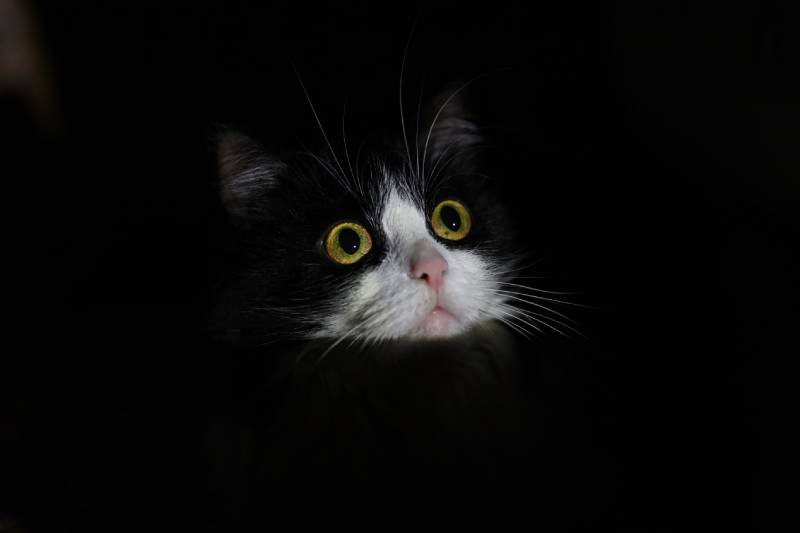
Rods in a cat’s eyes are responsible for peripheral and night vision, while cones are responsible for vision in bright light and color perception. Cats have more rod receptors than humans, but fewer cone receptors, so they see better in low-light conditions and have better peripheral vision.
In fact, cats have a 200-degree field of vision, while humans see about 180 degrees. This is a helpful tool for stalking prey and helps them avoid an attack from their own predators. Cats also track fast-moving objects well, even in darkness.
Though we can’t know for sure, researchers believe that cats see a much lower resolution. Humans can see at greater distances, typically 100 to 200 feet away, while cats can only see about 20 feet ahead.
What Are the Weaknesses of Cat Vision?
Cats have highly developed vision in some ways, which leads to the opposite in other ways. Cats have excellent night vision, but they can’t see as well in bright light or sunlight. Because they can track fast-moving objects and see better close-up than far away, cats wouldn’t be able to perceive a slow-moving object as well.
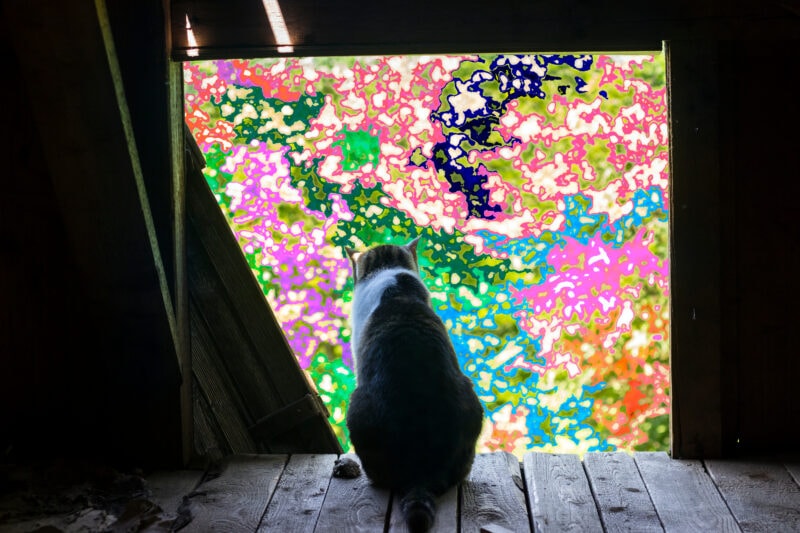
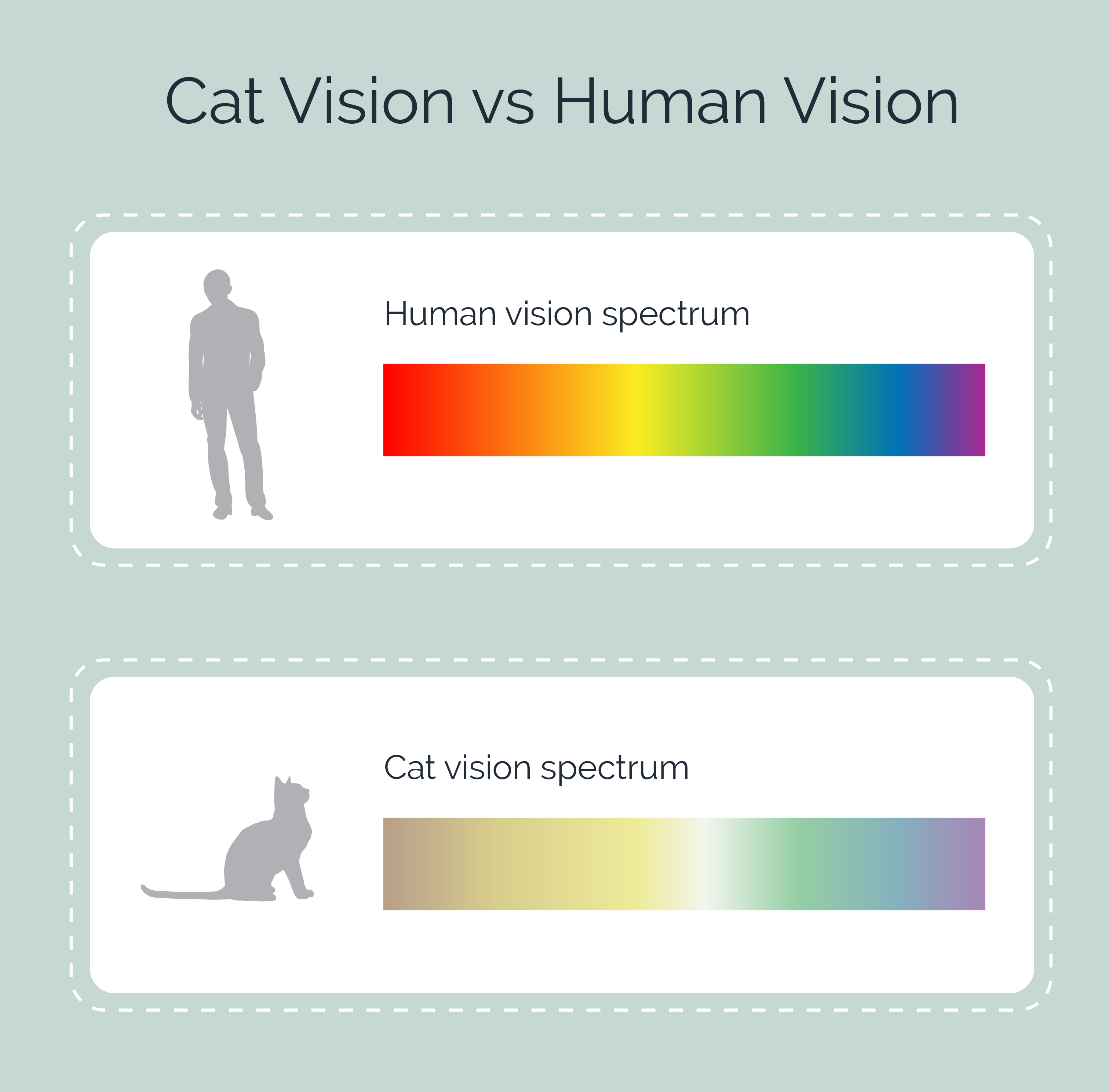
Color vision is different in cats as well. Humans are trichromats, which have three kinds of cones to perceive blue, red, and green. Cats may also be trichromats, but it’s believed that they see more green and blue than red or purple. So, a cat’s color vision is a lot like a color-blind human. Also, cats, like other animals, don’t have the same richness or variation in color vision as humans.
Pros
- Excellent night vision
- Superior peripheral vision
- Ability to track fast-moving objects
Cons
- Poor vision from afar
- Very little color perception
- Poor tracking of slow-moving objects

Overview of Human Vision
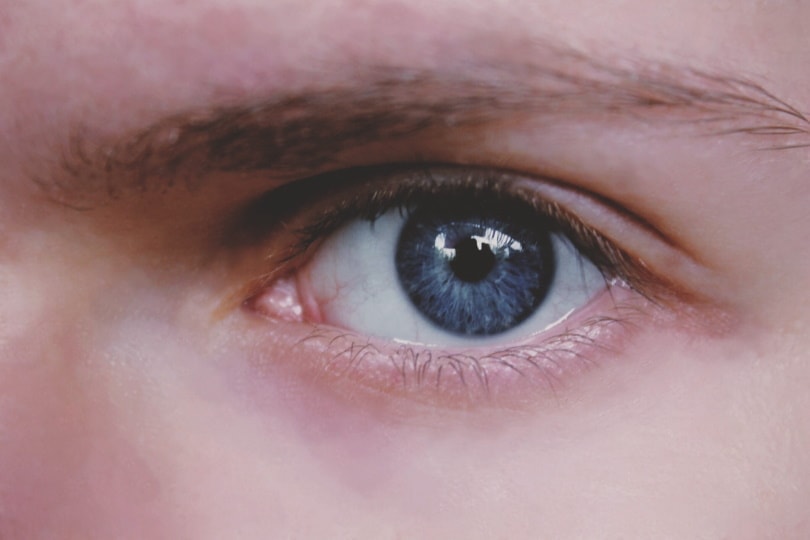
Humans have highly developed vision that allows us to see a wide range of colors and hues, adapt to bright or low light, see objects near and far, and spot both stationary and moving objects. We can also detect objects or movement on the edge of our peripheral vision, even if our range isn’t as wide as other animals.
Human Eye Structure
The human eye has many of the same components as a cat’s eye, such as a retina, cornea, lens, iris, pupil, and sclera. These structures function much in the same way as cats’ and other animals’ eyes, but the differences in the number of rods and cones, and the way our pupil contracts and dilates in response to light influence our vision strengths and weaknesses.
What Are the Strengths of Human Vision?
As diurnal (daytime) animals, humans see well in sunshine and bright light – much better than cats. Our retina has about 10 times more light receptors than cats, and it allows us to see vibrant colors in a range of values and hues. We can also detect motion better in bright light than cats can.
Humans have three types of cones, allowing us to see most of the color spectrum. While colors mostly enrich our lives now, the ability to see colors affected our ancestors’ survival. Poisonous plants, venomous animals, and other hazards can be identified by colors, which would be useful for ancient humans to protect themselves.
We also have a high-resolution vision. We can see sharp details both near and at a distance (assuming healthy vision) and can perceive slow-moving objects better than cats.

What Are the Weaknesses of Human Vision?
When we compare human vision to most animals, we fall short of the ability many predators have to track fast movement and make out objects and images in darkness or near-darkness. Though our eyes adapt to low-light conditions, we still need light to navigate and truly see what’s around us.
We also have more limited peripheral vision than cats and other animals. Prey animals, like horses and cows, have incredible peripheral vision to see predators from nearly all directions. This is partly because of the placement of their eyes on the side of their heads, whereas humans and cats are limited by front-facing eye orientation.
Pros
- Excellent daytime vision
- Fine detail and color perception
- Ability to see slow-moving objects
Cons
- Poor night vision
- Limited peripheral vision
- Difficulty tracking fast movement
Conclusion
Both cats and humans have highly developed vision and eye structures. Though each has its strengths and weaknesses, it’s safe to say that we have vision abilities designed for our evolutionary needs. Cats need to be able to see fast-moving objects, like rodents, and are nocturnal, so night vision is important for them. We are diurnal and rely on fine detail, vibrant colors, and sharp images for our survival.
Related Read: How Do Cat Eyes Work? Vet Reviewed Feline Physiology
Get Hepper In Your Inbox


Pet care tips from our vets and experts, straight to your inbox.
You may opt-out at any time. View our Privacy Policy for more information.

Nicole is a lover of animals of all sizes but is especially fascinated with the feline variety. She’s the proud mom of Baby, a Burmese, and works every day so he can relax in the sunshine or by the fire. She’s always had a cat in her home and has spent countless days with others, observing behaviors and softening up even the grouchiest of the lot. Nicole wants to share her kitty expertise with you so you and your cat can live happy, healthy, and care-free.
Join the conversation
Ask a question, share your story, or send private feedback.