Hepper is reader-supported. When you buy via links on our site, we may earn an affiliate commission at no cost to you. Learn more.
Heimlich Maneuver for Dogs: How to Save Dogs From Choking (Vet-Reviewed Guide)



Some dogs will chew on just about anything they can get their paws on or try to swallow objects that are inedible or food chunks that are too big for their mouth. This can be quite dangerous. If you've ever found yourself in the company of a human that's choking, you know how terrifying it can be. Now imagine it's your beloved dog that's choking. They can't tell you that they need help. You need to identify the signs, get someone to immediately call your vet for advice and to assist you (unless you can get your pet to a vet clinic in time), or jump right into action if your dog is struggling to breathe.
Whether you've recently had a choking scare or are just trying to brush up on your animal first aid skills, we can help. Keep reading to learn how to perform the Heimlich maneuver on dogs.
Do be aware that the Heimlich maneuver for a dog should ideally be performed by a trained professional, but this is often not possible. If done incorrectly, it may lead to injuries to your dog or not clear the blockage. Speak to your vet during regular health checks on how to perform this procedure on your dog so you feel prepared should there ever be a need to do it.

What Is the Heimlich Maneuver?
You have probably seen the Heimlich maneuver performed on TV or in movies. The Heimlich maneuver is a first aid procedure that's necessary when the upper airway is obstructed by a foreign object. Dr. Henry Heimlich is credited with founding this procedure in the 1970s.
Many people don't realize that the Heimlich maneuver isn't explicitly reserved for humans. You can perform this life-saving procedure on dogs too.

Before You Begin
The Heimlich maneuver can cause serious harm if it isn't done correctly or if it's performed on a pet that isn't choking in the first place. Although time is of the essence in an emergency, there are some things you must do before you jump into the Heimlich maneuver.
Ideally, this procedure would be performed by a veterinarian, but unfortunately, there is often no time to get a choking dog to the vet. Familiarize yourself with these steps and the Heimlich maneuver, so you will have a cool head if your dog ever starts choking.
Determine If Your Dog Is Choking
Before you begin the procedure, check for the following choking signs:
Dogs may cough or gag due to other health reasons, such as tracheal irritation, heart disease, and upper respiratory infection, so a coughing dog may not necessarily be choking. Retching and gagging may be a prelude to vomiting, rather than a sign of choking.
However, if your dog was just eating a chew or tearing up a toy a minute ago and now they are showing the aforementioned signs of distress, there is a chance that they are choking.
Check for Foreign Objects
If your pup exhibits signs of choking, you must determine what sort of object they are choking on and whether it can be quickly removed directly from their mouth.
Begin by carefully checking the inside of their mouth to see if there are any foreign objects in their throat or at the back of the mouth. Be mindful that dogs that are choking will panic as they struggle to breathe, and they may inadvertently bite, so place your fingers in their mouth cautiously, and be ready to remove them quickly. If you see something blocking the airway, use your finger to try to grab and sweep it out.
If you cannot reach the object or if it doesn't budge when you try to sweep it away or grab it, you can rush your pup to the emergency vet if they are not struggling to breathe, as the foreign body in the mouth is not obstructing the airway and they are fit enough to be transported, or you can begin the Heimlich maneuver if there is no time and your dog’s gums are becoming blue.
If the object lodged in your dog's mouth is a bone and it’s not obstructing their airway, do not try to remove it at home. Bones can have sharp pieces, which can cause serious injury to the mouth and tongue. In this situation, a visit to the emergency vet is unavoidable. Your veterinarian can sedate your dog to prevent further injuries and to calm them while removing the foreign body.
Don't Panic
If your dog is choking and you cannot remove the object from the back of their throat, or if you can’t see it and they are struggling to breathe, the next step is to keep a cool head and get on with the Heimlich maneuver. We know it's much easier said than done, but panicking in an emergency situation like this can make matters worse. So, take a deep breath and get to business.

How to Perform the Heimlich Maneuver on a Small Dog
The method you use for performing the Heimlich will depend on the size and breed of your dog. Small dogs will require a different technique than their larger counterparts.
1. Pick Up Your Small Dog
Pick up your pet, and hold them with their back to your chest. Approach your dog carefully and use a soothing voice. Even the gentlest dog can bite when there’s something in their mouth blocking their airway and making it hard to breathe.
2. Find the Right Spot
Use the palm of your hand, and place it on their abdomen, just behind the rib cage.
3. Apply Pressure
Apply pressure to this spot. Push inward firmly and upward five times in a thrusting motion.
4. Check the Mouth
After applying pressure, check your dog's mouth to see if the object lodged in their throat became loose during step three.


How to Perform the Heimlich Maneuver on a Large Dog
You won't be able to pick up and hold your dog in your lap if they’re a large breed, so the procedure for performing the Heimlich will be different for your bigger pup.
1. If Your Dog Is Standing
If your dog is standing, wrap your arms around their body, and join your hands around their belly. Then, make a fist, and press firmly upward just behind their ribcage, repeating the motion five times. Afterward, check your pup’s mouth to see if the object has moved or has been coughed out.
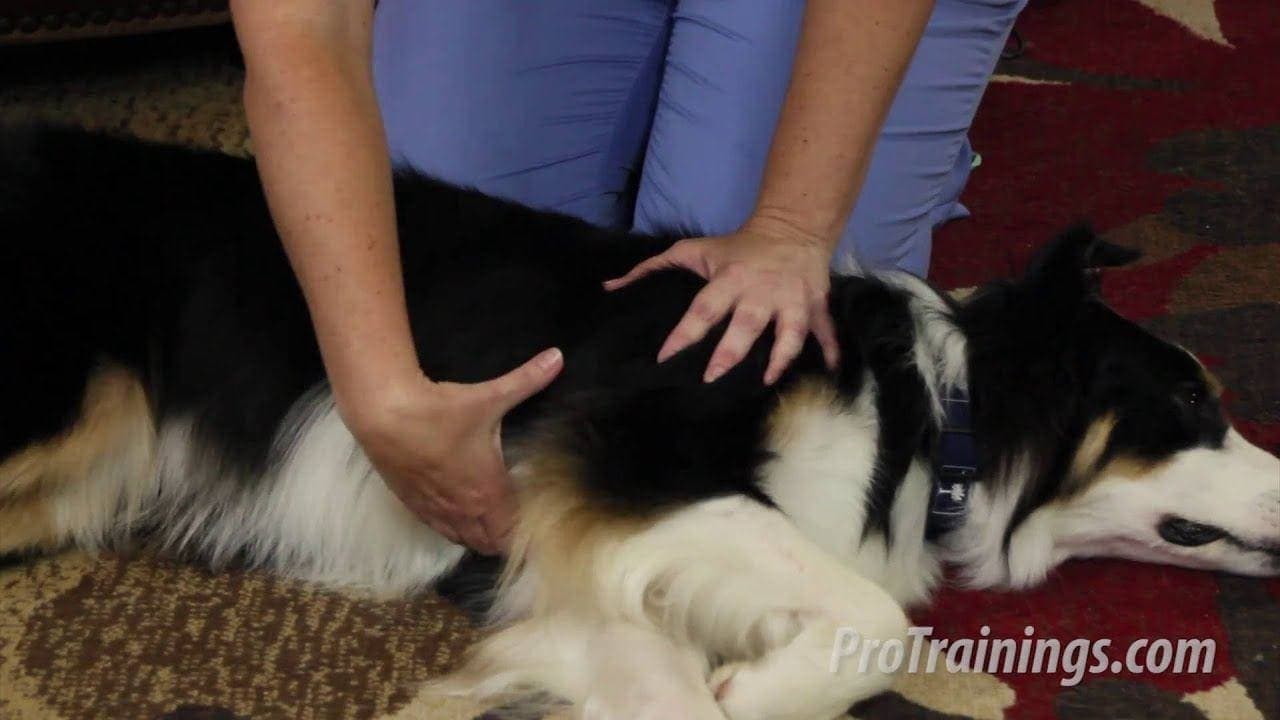
2. If Your Dog Is Lying Down
If your pup is lying down, put one of your hands on their back for support while using the other to apply pressure to their abdomen, just behind the rib cage. You should be pressing upward and forward toward your dog's spine, in the direction of their head.
3. Check the Mouth
Check your dog's mouth to see if any objects were dislodged using the previous techniques.

After the Choking Stops
Even if the Heimlich maneuver was successful and your dog seems fine, you still need to contact your vet.
Your pup may have gone without oxygen for some time while choking, which can require hospitalization. Choking can also cause damage to the mouth or throat that you may not be able to recognize.
Your vet can give your pup a once-over to ensure that there was no trauma done to the chest during the Heimlich.
How to Prevent Choking
Choking is terrifying for you and your dog, so the best thing you can do as a pet owner is to try to prevent it.
- Be watchful. Treat your dog as if they were a small child. You can't stop either from exploring with their mouths, but you can take steps to ensure they're not getting into any serious trouble. Keep an eye on your dog as much as you can, or consider crate training them for when you’re not around.
- Choose safe toys, and don’t leave your dog unsupervised while they're chewing. Always supervise your dog when they’re gnawing on chews or playing with chew toys. Be particularly mindful of the dangers associated with chewing or fetching sticks that may become lodged in the throat. Once your dog's chew toys, bones, or rawhides become small enough to fit in their mouth, throw them away. If your dog is a powerful chewer and quickly destroys chews, especially by breaking off large chunks, consider more durable options, such as hard KONG toys filled with food.
- Be bone smart. Bones are not always safe or appropriate for domestic canines, though this will greatly depend on the type and size of the bone and the dog. Not all dogs should be given bones, depending on their chewing preferences. Bones may damage the mouth and teeth while the dog is chewing, and some dogs may try to swallow large bone pieces. This can lead to choking, gastrointestinal obstruction, constipation or stomach upset in general. If you offer bones to your dog, never give them one that's small enough to fit completely in their mouth, and always supervise them during chewing sessions. Take the bone away when it becomes too small. Cooked bones are particularly hazardous because they can break easily into sharp fragments, which may make it easier for them to damage the dog’s mouth or cause obstructions if swallowed.
- Choose the appropriate size of kibble for your dog. If your dog’s kibble is too big or small for their size or they "inhale" their food rather than chew (common among food-motivated dogs), they may struggle to properly swallow, which may lead to choking. Fast eaters can be slowed down with puzzles, lick mats, food-filled toys, and slow feeders.

Final Thoughts
Choking in canines happens more often than you might think, so knowing how to respond if it happens to your dog is essential. Now that you know how to check your dog’s mouth and how to do the Heimlich to save your pup's life, you might want to consider expanding your first aid skill set and inventory. Check out our blog on the best dog first aid kits to get started, and speak to your vet for a first-hand demo and guidance.
See also:
Sources
Featured Image Credit: McGraw, Shutterstock
Get Hepper In Your Inbox


Pet care tips from our vets and experts, straight to your inbox.
You may opt-out at any time. View our Privacy Policy for more information.
Chantelle's life revolves around two passions: writing and animals. Raised on the prairies of Canada amidst a menagerie of pets, she now lives with five cats, two guinea pigs, and a bearded dragon. Together with her husband and child, Chantelle delights in being an exemplary animal parent, going as far as installing wall-mounted cat shelves to give their cats an indoor playground. When she's not cozying up with her cats or snapping their amusing antics, she enjoys venturing into the Rocky Mountains, binge-watching her favorite Netflix shows, and indulging in spontaneous reading adventures.
Join the conversation
Ask a question, share your story, or send private feedback.