Hepper blog

Search our database of over 9,984 posts with up-to-date information from our experts and veterinarians.

Hepper is reader-supported. When you buy via links on our site, we may earn an affiliate commission at no cost to you. Learn more.

How Many Muscles Does a Cat Have in Each Ear? Vet-Reviewed Facts

By Rachael Gerkensmeyer · Reviewed & fact-checked by Dr. Paola CuevasVet Approved
Dr. Paola Cuevas
Reviewed & Fact-Checked byDr. Paola CuevasMVZ (Veterinarian)
Paola Cuevas is a veterinarian and animal behaviorist, with over 18 years of experience working with a variety of species. Her passion is animal welfare and focuses on the importance of preventive medicine. Paola has skills in the fields of nutrition, microscopy, clinical pathology, diagnostic imaging, and endoscopy as well as extensive experience in animal training through positive reinforcement. As our in-house veterinarian, Paola is very happy to share her knowledge and experience with our readers and hopes to be helpful with any issue presented by your non-human family members.View authorThe information is current and up-to-date in accordance with the latest veterinarian research. Read about our vets
Share
Ask us a question in the comments
close up of a cat's ear

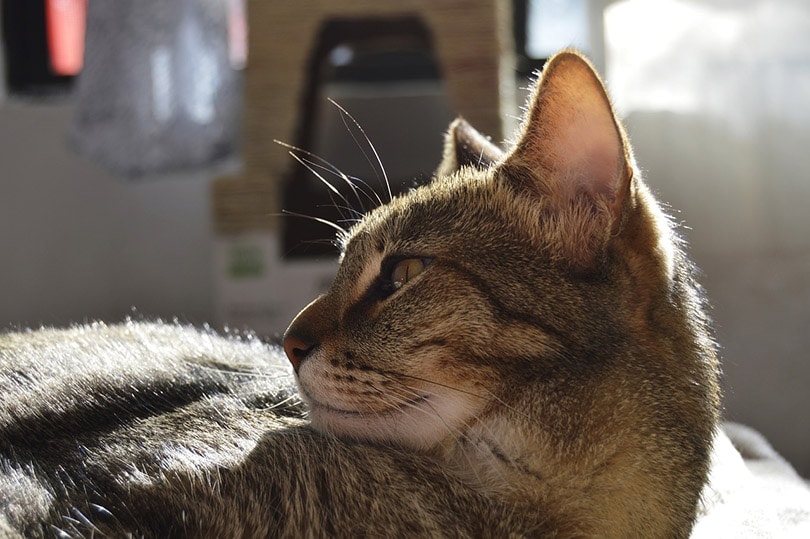
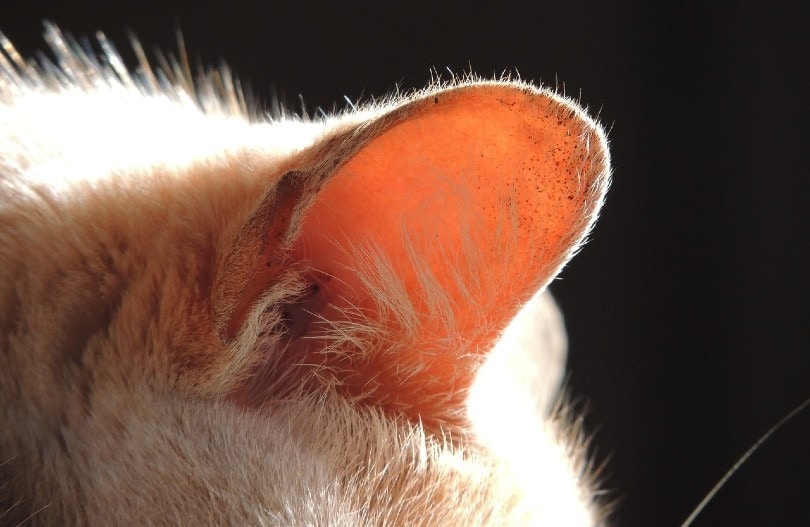
Cats’ ears are adorable! Have you ever wondered how they work? They seem to swivel around on their heads independently, so they must have special features, right? The truth is that a cat’s ears work like our ears do, but they have many more muscles inside them. In fact, there are more than 29 muscles found in each ear! Keep reading to learn more.

The Number of Muscles in a Cat’s Ear

There is a total of 32 individual muscles that are responsible for the movement of a cat’s ear. Each ear can move independently of one another and can move in different directions simultaneously. Their ears are capable of pivoting about 180 degrees around in either direction. The ears on a cat typically stand erect and rarely fold over as a dog does. Only rare breeds, such as the Scottish Fold, have floppy ears that fold down.

A cat’s ears can be observed rotating to the side and behind them when they hear unknown sounds. The ears may also fold backward while hissing or playing. They can also point back while moving their bodies forward.

The Structural Components of a Cat’s Ear

There are three structural components of a cat’s ear: the outer section, the middle section, and the inner section. The outer ear, also referred to as the pinna, is the section of the ear that protrudes from the cat's body. This part of the ear catches sound waves and directs the waves into the ear canal, where they travel to the middle ear component.

The middle ear components vibrate as the sound waves travel through to the inner ear, where the vibrations are perceived and sent to the auditory system. From there, the auditory system translates the sound waves to the brain and allows the cat to make sense of the sounds they are hearing.
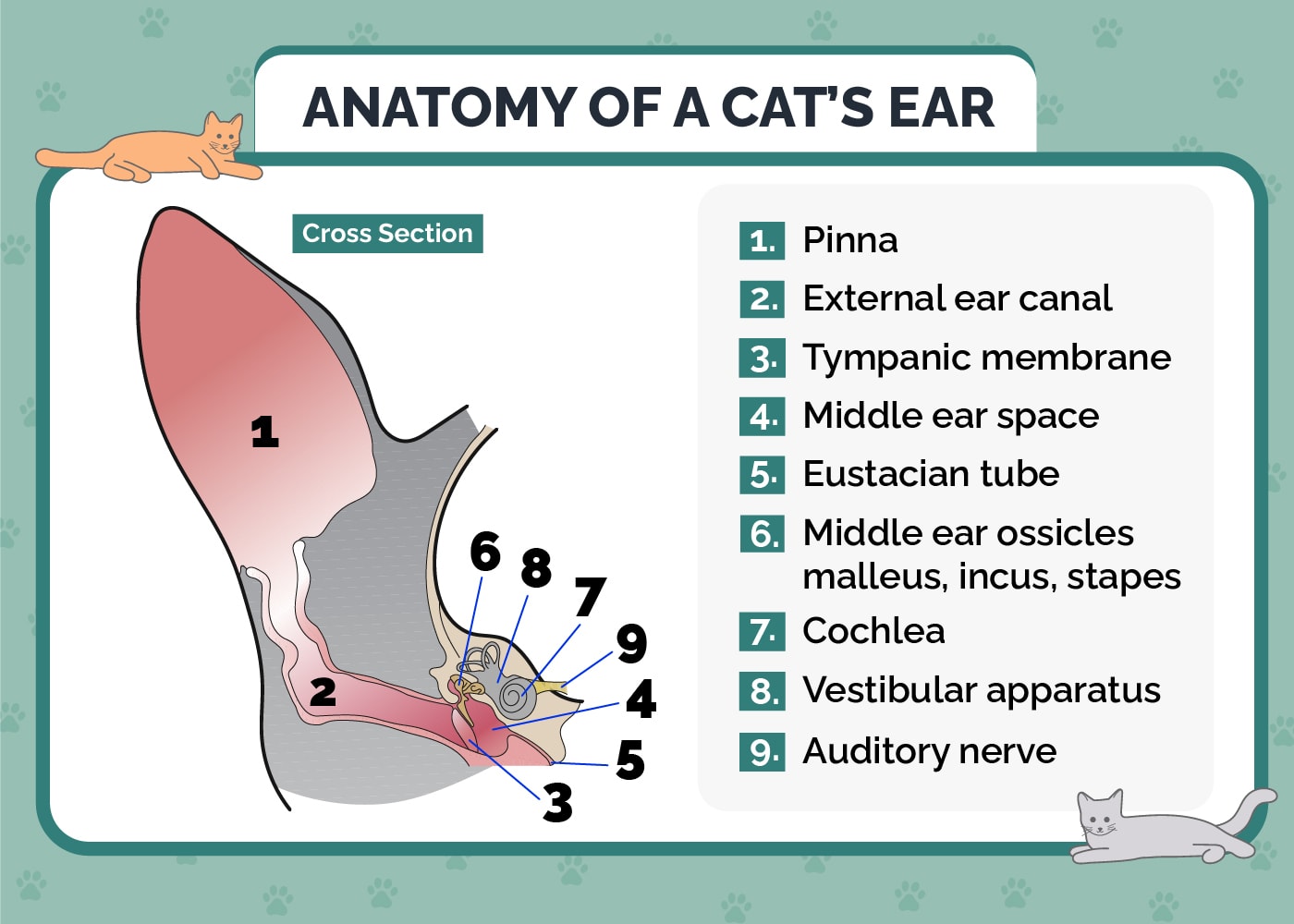
Hepper_Anatomy of Cats Ear_Infographic_v1-1_May 4 2023
You are free to use this image but we do require you to link back to Hepper.com for credit

The Effectiveness of a Cat’s Hearing

Cats have fantastic hearing. They can hear low octaves about as well as humans can, but they can hear higher-pitched noises much better than we can. They can even hear higher-pitched sounds than dogs can. Therefore, you can expect that whatever you can hear, your cat can hear too. On the other hand, your cat can probably hear things that you can’t, so if they seemingly head to a window to see what is outside, there might be something out there that you should check out too.

Unfortunately, white cats are susceptible to deafness. Some are born deaf, while others develop deafness as they age. Not all white cats have to deal with deafness, but up to 20% of white cats are born deaf. The number is even higher for white cats with blue eyes! Up to 40% of white cats with one blue eye are born deaf, while up to 85% of white cats with two blue eyes are born deaf.

Some white cats are deaf in both ears, but many are deaf in only one ear. Cats that are completely deaf make excellent pets, but they must be kept inside the home and in areas where they don’t require auditory signals to stay safe.

side view of a cat's face
Image by: Pixabay, Pexels

Conclusion

Cats have cute ears, but they are not only there for our pleasure. They serve to keep cats safe from threats, like stray dogs and passing vehicles. They also allow us to effectively communicate with them, hence how they learn to come when we call them. However, speech is not the only way we can communicate with our cats, such as through touch and body language, which is what makes deaf kitties great pets.

See also:


Featured Image Credit: invitacionestan27, Pixabay

Get Hepper In Your Inbox

Pet care tips from our vets and experts, straight to your inbox.

List

Select all that apply.

You may opt-out at any time. View our Privacy Policy for more information.

Rachael Gerkensmeyer
Authored by

Rachael Gerkensmeyer

Join the conversation

Ask a question, share your story, or send private feedback.

Rate this post
Required to post. Only our editors see your rating.
Who should see this?

A human reviews every comment before it appears. Your email is never published.

Picked to go with this article

How Many Muscles Does a Cat Have? Vet-Reviewed Facts & FAQ

How Many Muscles Does a Cat Have? Vet-Reviewed Facts & FAQ

Cats are agile creatures with flexible bodies. These muscles help cats hunt, claw, pounce, and climb. Since they are obligate carnivores, you can imagine how v…

Ashley Bates
By Ashley Bates ·
Can Cats Hear Better Than Dogs? Vet-Approved Facts & FAQs

Can Cats Hear Better Than Dogs? Vet-Approved Facts & FAQs

Everyone knows that cats and dogs have physical abilities that put ours to complete shame. Dogs can detect cancer and conditions such as hypoglycemia, and cats…

Lorre Luther
By Lorre Luther ·
How Far Can Cats Hear? Fascinating Feline Facts

How Far Can Cats Hear? Fascinating Feline Facts

Cats have an exceptional sense of hearing that's more refined than that of humans and dogs! While cat ears are small and delicate, their anatomy is complicated…

Nicole Cosgrove
By Nicole Cosgrove ·
11 Facts About Your Dog’s Ears: Vet-Reviewed Guide

11 Facts About Your Dog’s Ears: Vet-Reviewed Guide

Dog ears come in all shapes and sizes, but no matter what your dog’s ears look like, they’re probably as cute as a button! Their ears are one of their top mean…

Brooke Billingsley
By Brooke Billingsley ·

Keep reading

More stories you might like

Cat Anatomy Basics: 9 Essential Feline Body Parts

Most of us don't think too much about cat anatomy. We know what they need to survive and thrive, and for many of us, that's good enough. However, you're truly…

Chantelle Fowler
By Chantelle Fowler ·
Cat Anatomy Basics: 9 Essential Feline Body Parts

How to Tell if Your Cat Is Deaf? 5 Vet-Approved Signs to Look For

Deafness in pets, but specifically cats, might be more common than you'd think. Senses can deplete as any creature ages. These are just facts of life. If your…

Ashley Bates
By Ashley Bates ·
How to Tell if Your Cat Is Deaf? 5 Vet-Approved Signs to Look For

11 Incredible White Cat Facts You'll Be Surprised to Learn

There’s no doubt that cats are amazing creatures, which is probably why they're the 2nd most popular pet in the United States. They come in a wide variety of c…

Gregory Iacono
By Gregory Iacono ·
11 Incredible White Cat Facts You'll Be Surprised to Learn

Why Do Cats Put Their Ears Back? 3 Possible Reasons (Vet Reviewed)

Cats are extremely expressive little creatures. They communicate not only through mews and hisses but also through body language. One of the easiest ways to de…

Nicole Cosgrove
By Nicole Cosgrove ·
Why Do Cats Put Their Ears Back? 3 Possible Reasons (Vet Reviewed)

What Is Henry’s Pocket? Vet-Verified Feline Anatomy Facts & Mysteries

You might not recognize the name, but if you’ve ever looked closely at a cat, you will see that little fold of skin on the edge of a cat’s ear. It’s right down…

Chelsea Mortensen
By Chelsea Mortensen ·
What Is Henry’s Pocket? Vet-Verified Feline Anatomy Facts & Mysteries

Cats With Two Different Eye Colors: Vet-Reviewed Causes & Concerns

All cats have beautiful eyes, and most have the same-colored eyes, but not all of them. Cats that have two different eye colors give them a unique look that us…

Rachael Gerkensmeyer
By Rachael Gerkensmeyer ·
Cats With Two Different Eye Colors: Vet-Reviewed Causes & Concerns

Can Cats Smell Mice? Feline Senses Explained

Cats have several superpowers, including a fantastic sense of smell. They have 45 to 200 million smell receptors1 in their little noses. Humans, on the other h…

Lorre Luther
By Lorre Luther ·
Can Cats Smell Mice? Feline Senses Explained

How Do Cat Eyes Work? Vet-Reviewed Feline Physiology

Have you ever watched your cat chasing after a bug or climbing a cat tree and wondered how your kitty sees the world? Do our favorite felines see shapes and co…

Misty Layne
By Misty Layne ·
How Do Cat Eyes Work? Vet-Reviewed Feline Physiology