Hepper is reader-supported. When you buy via links on our site, we may earn an affiliate commission at no cost to you. Learn more.
Can Cats Smell Mice? Feline Senses Explained

In this article
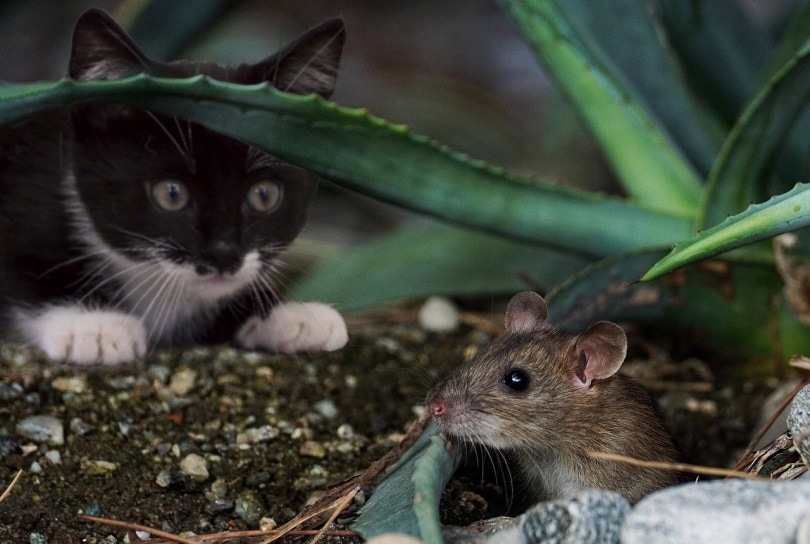
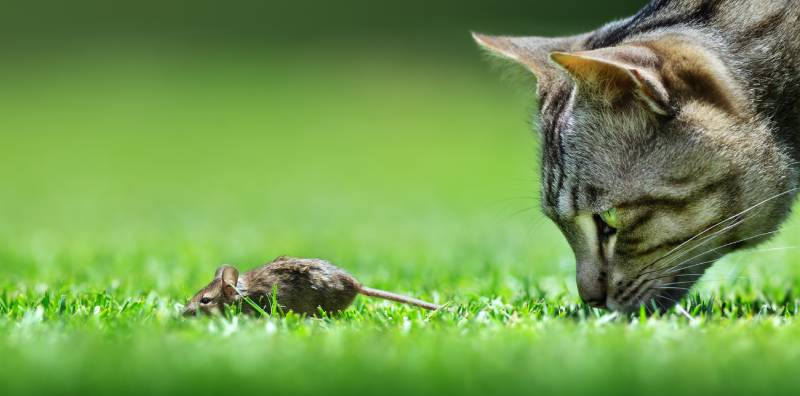
Cats have several superpowers, including a fantastic sense of smell. They have 45 to 200 million smell receptors1 in their little noses. Humans, on the other hand, only have 5 million. Cats use scent to identify family members and to learn more about the health and reproductive status of fellow felines. They also use noses to detect mice and other prey.
Cats rely on smell more than vision to understand the world. They also use hearing and vibrations picked up through their whiskers to locate and catch prey. Read on for more on your cat’s adorable nose and information about how they use their senses to navigate their universe.

Cats & Their Sense of Smell
Cats have around 40 times more scent receptors than humans, and their sense of smell is 14 times better than ours. Cats actually have two scent organs: their noses and a vomeronasal organ dedicated to detecting pheromones. They also use urine to mark territory and let other animals know an area has already been claimed. When your cat sniffs something and then curls its lips, it’s drawing scent molecules into its vomeronasal organ.
Cats have scent-producing organs around their ears, tails, and between their paws. A few more can be found under your pet’s chin and cheeks. These scent glands produce those pheromones which cats spread by rubbing against people, other cats, and objects in their environment. It’s also just one of the many reasons cats love to scratch things; it gives them a nice stretch and allows them to leave their scent signature behind in a prominent location of their choice.
Cats are programmed from birth to smell their way to food. Blind kittens rely on their noses to find their mother instead of their eyes, and kittens usually sniff their way to their first meal within hours after birth. Cats can even smell treats from as far as 150 feet away.
Cats & Sight
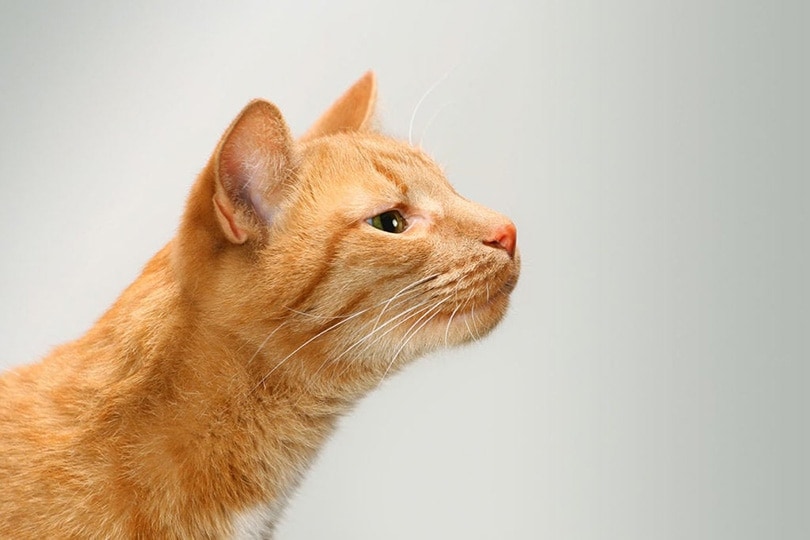
Cats have amazing eyes, but feline vision differs markedly from ours. Cats cannot see well far away or up close. Feline eyes sit far forward on their faces, which provides an advantage in determining distance. Cats have more rods in their eyes than humans, giving them a boost in night vision and picking up on subtle movements. Humans, on the other hand, have more cones than cats, giving us better visual acuity in bright conditions.
The feline sense of sight is developed to give them an advantage when hunting during their favorite hours, dusk and dawn. Cats have an organ, the tapetum lucidum, that reflects light and gives a serious edge when it comes to seeing and hunting in low light.
Their pupils open into wide circles to allow light to enter their eyes, and feline vision excels at detecting movement and contrast, making it easy for cats to see small movements in the dark. They also have a 200-degree range of vision, permitting them to pick up on movements in a wide area in one glance.
Cats & Hearing
Cats have amazing hearing. They can probably hear sounds produced around five times further away than human ears are capable of picking up on. That adorable recognizable feline ear shape actually contributes to their fantastic auditory skills. The outer ear, otherwise known as the pinna, funnels sound toward the cat’s middle ear.
The outer ears feature 32 individual muscles that allow cats to move their pinna 180 degrees to locate sounds precisely. Dogs, in comparison, only have 18 ear muscles! Cats can move each pinna independently in response to auditory stimuli. The vestibular apparatus, located in the inner ear, helps cats stay balanced when jumping and right themselves after a fall.
Believe it or not, cats have better hearing than dogs, at least at some high frequencies. Cats can hear in a range from 45 Hz to 64 kHz, while dogs are only able to distinguish sounds in the 67 Hz to 45 kHz range. In case you were wondering, humans can generally pick up sounds between 20 Hz and 20 kHz. Cats collect information from each ear independently, which they then compare for intensity and speed to triangulate the location from which sounds are coming.

Cats and Whiskers
Cats also use their whiskers to keep track of small prey like mice scurrying underfoot. Because they can’t see well up close, cats interpret vibrations picked up through their whiskers to hone in on nearby critters.
Cats’ whiskers are connected to several nerve receptors and can “feel '' environmental characteristics like temperature and air pressure changes, air current movements, and wind direction shifts. These nerve receptors transmit this detailed information to sensory cells that allow your cat to “see” through their whiskers.
Most cats have 12 whiskers on each cheek. The whiskers above your pet’s eyes and on their muzzle allow them to gauge whether they can safely fit through narrow spaces. Most also have carpal whiskers on their front legs close to the paw joint that let them “see” the movement of prey through feel.

Conclusion
Cats can indeed smell mice. As predators, cats’ senses developed to help them quickly find prey such as mice, small rabbits, and birds. They also rely heavily on hearing and their sensitive whiskers to track nearby rodents. Since mice and other nocturnal animals are active at night, they are vulnerable to a cat’s superior night vision that complements their enhanced sense of smell. Although a cat may initially detect a mouse by its scent, its other developed senses help it hone in on its target.
See Also: Does Having Cats Keep Mice Away?
Sources
https://www.purina.co.uk/articles/cats/kitten/play/cat-senses
https://www.petmd.com/cat/behavior/evr_ct_why_do_cats_have_whiskers
https://excitedcats.com/how-many-muscles-do-cats-have-in-each-ear/
https://iheartcats.com/9-amazing-facts-about-your-cats-ears/
https://www.petmd.com/cat/care/cat-facts-10-interesting-things-about-cat-ears
https://www.petmd.com/cat/care/cat-facts-10-interesting-things-about-cat-ears
https://vcahospitals.com/know-your-pet/why-do-cats-have-whiskers
https://www.petmd.com/cat/slideshows/ultimate-guide-cat-vision
https://betterwithcats.net/how-many-whiskers-does-a-cat-have/
https://www.battersea.org.uk/pet-advice/cat-advice/cats-sense-smell
https://www.catsonbroadwayhospital.com/the-five-senses-according-to-cats-hearing/
https://www.petmd.com/cat/general-health/cat-sneering-what-flehmen-response
https://www.thepurringtonpost.com/comparing-vision-cats-vs-humans/
Featured Image Credit: Etienne Outram, Shutterstock
Get Hepper In Your Inbox


Pet care tips from our vets and experts, straight to your inbox.
You may opt-out at any time. View our Privacy Policy for more information.
Lorre Luther a reformed lawyer from the United States, she moved to the Netherlands to follow her dream and become a writer. Currently living in Rotterdam, Lorre enjoys traveling and reveling in the astonishing beauty of our planet. As an animal lover, Lorre is convinced that cats are smarter than humans.
Join the conversation
Ask a question, share your story, or send private feedback.