Hepper is reader-supported. When you buy via links on our site, we may earn an affiliate commission at no cost to you. Learn more.
How to Clean a Bearded Dragon Tank? 6 Tips & Tricks
In this article
Keeping your Bearded Dragon’s tank clean and maintaining a hygienic environment is an important aspect of regular care. Cleaning your Bearded Dragon’s enclosure prevents dirt and germs from building up, which can put your Bearded Dragon at risk for diseases, parasites, and mold. Like most pets, Bearded Dragons require daily care.
Since cleaning a Bearded Dragon tank can be bewildering at first, this article will guide you through the tips and tricks that can make the cleaning process a whole lot easier.

The 6 Tips & Tricks for Cleaning Bearded Dragon Tank
1. Make a List of the Things That Need Cleaning
Even if you feel that Bearded Dragons aren’t very messy pets, there are probably things that need cleaning in their tank that you overlooked. This includes things like the substrate, water and food bowls, tank glass, tiles, and any decorations. The majority of the surfaces in your Bearded Dragon’s tank will need to be cleaned fairly regularly.
Making a checklist of all the surfaces, items, and substrate in the tank that needs cleaning will help prevent you from missing a step. You can create a list on your smartphone or a piece of paper, and mark through all the items you have already cleaned. This can make the cleaning process much quicker.
If you find it difficult to stay on track with cleaning your Bearded Dragon’s tank, you can set an alarm or reminder on your phone for the days when you need to clean it.
2. Make a Routine for Both Spot and Deep Cleaning
There are two types of cleaning you will do in a Bearded Dragon cage. The first one is spot cleaning, which is a short cleaning process where you remove any soiled substrate and leftover food and refill the water dish.
The longer cleaning process is deep cleaning, which is when you will spend time sanitizing and maintaining the enclosure. While spot cleaning can be done every 1–3 days, deep cleaning is usually done every 1–2 weeks. The intensity of the spot or deep cleaning that you will do will depend on how messy your Bearded Dragon is, their food or substrate type, and the type of tank you set up (bioactive or standard).
3. Keep Your Bearded Dragon in a Safe Space
While you are cleaning a Bearded Dragon enclosure, it is important to move them to a safe place. This not only prevents your Bearded Dragon from getting in your way during the cleaning but also keeps them safe and away from cleaning solutions. Your Bearded Dragon may also attempt to escape while you are distracted with cleaning. Instead of leaving them in the tank, rather place them in a secured carrier. This can be the carrier you would use to travel or take your Bearded Dragon to the veterinarian. The bottom of this carrier should be lined with paper towels to absorb any mess.
4. Remove Uneaten Food and Soiled Substrate, and Refill the Water
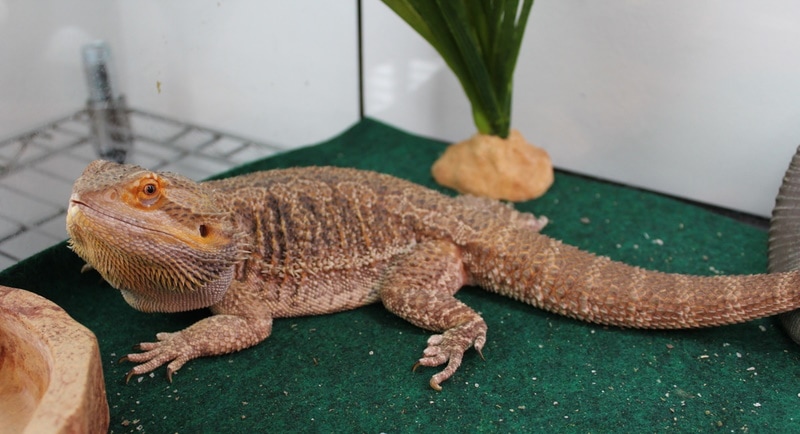
Once your Bearded Dragon is somewhere safe and out of the tank, you can begin cleaning it. Turn off the heating and lighting equipment so it doesn’t interfere with your cleaning. Removing uneaten food and refilling the water dish can be done during both spot and deep cleaning.
Start by removing any leftover food that your Bearded Dragon hasn’t eaten, including live insects. This prevents the food from fouling as it sits in the tank, which can create an unhygienic environment. You should also remove the food and water bowl so that they can be rinsed under warm water and dried. Lastly, any soiled substrate that has food or waste on it should be removed. Be sure to wash your hands thoroughly after handling old food and any poop.
Once the food and water dish has been rinsed, you can refill them to be placed back into the cage. If you removed large portions of the substrate, you might need to add a fresh batch. However, if you are doing a deep clean, you should remove all of the substrate entirely and replace it with fresh substrate.
Any tank liners, tiles, or carpets should be washed to remove any gunk.
5. Use Safe Cleaning Solutions
Using safe and non-toxic cleaning solutions in your Bearded Dragon’s tank is important. This likely means that you will need to purchase or make your own cleaning solution for your Bearded Dragon rather than using household products. You can either create a solution of white vinegar and water or buy a cleaning solution that has been specifically formulated for reptiles.
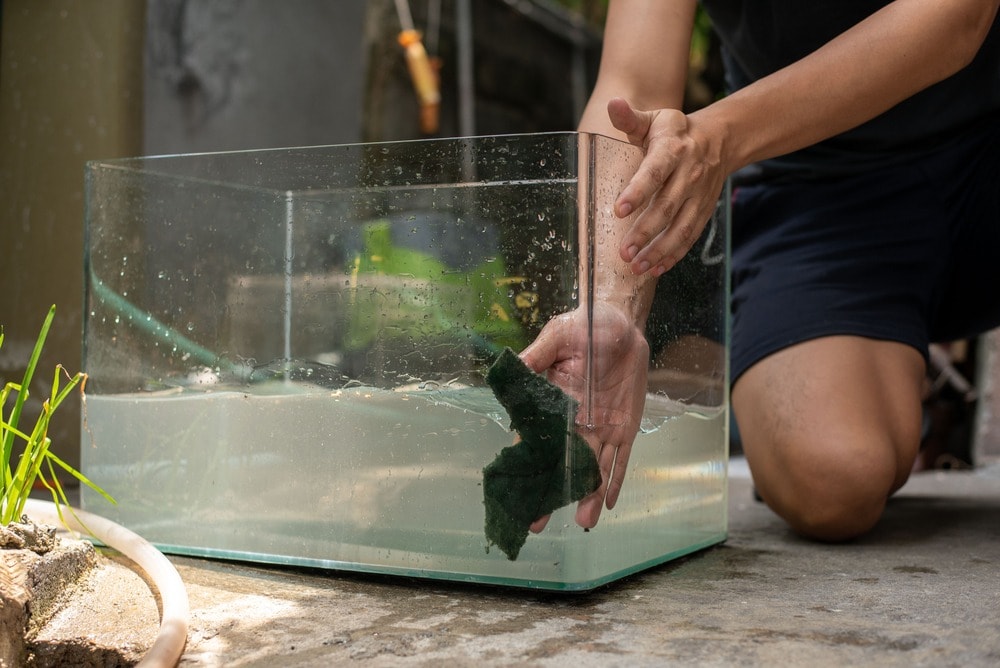
You can use the solutions to clean and sanitize your Bearded Dragon's feeding bowls, any decorations, and the bottom of the tank. The solution of water and white vinegar is also great at cleaning the glass of the tank without leaving visually disruptive streaks and residue.

6. Check That the Equipment Is Functioning Properly
A step that many people might forget is to check that all their Bearded Dragon's lighting and heating equipment is working. This is incredibly important, especially if you don't have a reptile thermostat.
You should check that the heating lamps, UV lights, and any lights are functioning properly. The heating lamps or bulbs should be producing heat, and that the UV lighting is not due for a replacement. If the heating and lighting fixtures are a bit dusty, turn them off for a few minutes until they have cooled down. You can then use a clean, non-abrasive cloth to remove the dust.
Before placing your Bearded Dragon into the clean tank, you should turn on all the heating and lighting equipment. Let them run for a couple of minutes and check that the thermostat or thermometer is showing a desirable temperature for your Bearded Dragon.
Cleaning a Bioactive Bearded Dragon Tank
Housing your Bearded Dragon in a bioactive tank is a great way to replicate a natural habitat for them. You are likely using a bioactive substrate with plants, natural items, and even a cleanup crew of springtails, isopods, or earthworms. When it comes to cleaning bioactive tanks, you won't need to remove and clean everything very often.
This is not only tedious but removes the purpose of the bioactive tank in the first place. However, you will still clean the tank when necessary, especially while the cleanup crew is still establishing itself. You will also need to clean your Bearded Dragon’s water and food bowl and refill it when necessary. A diluted solution of white vinegar and water can still be used to wipe down the tank’s glass.
Once the cleanup crew has established itself, they will begin taking care of the waste and leftover food. In some cases, larger amounts of waste in the cage will still need to be cleaned by you, since you don’t want your Bearded Dragon sitting in a soiled enclosure.
Conclusion
Maintaining your Bearded Dragon's tank regularly is going to keep it clean and fresh so that your Bearded Dragon is kept in a hygienic environment. Once you get the hang of things, it probably won't take you more than 20 minutes to perform a deep clean in their tank. Spot cleanings are going to take much quicker, which is why they can be done daily.
Sources
Featured Image Credit: MARVIK, Shutterstock
Get Hepper In Your Inbox


Pet care tips from our vets and experts, straight to your inbox.
You may opt-out at any time. View our Privacy Policy for more information.

Sarah is residing in South Africa with her partner and pets. She currently is interested in veterinary science and ichthyology, which she wants to study alongside her main passion: pet content writing. Sarah has over 60 fish including goldfish, tropicals, shrimp, and snails. She also keeps hamsters and a tarantula and wishes to provide quality content for readers and allow others to learn from her knowledge and experience. Sarah has much experience in all aspects of pet care, and providing the world with knowledge on ethical pet ownership is her lifelong dream.
Join the conversation
Ask a question, share your story, or send private feedback.