Hepper blog

Search our database of over 9,984 posts with up-to-date information from our experts and veterinarians.

Hepper is reader-supported. When you buy via links on our site, we may earn an affiliate commission at no cost to you. Learn more.

How to Set Up a Pacman Frog Enclosure: 4 Important Tips

By Codee Chessher · Written by Dr. Karyn KanowskiVet Approved
Dr. Karyn Kanowski
Reviewed & Fact-Checked byDr. Karyn KanowskiVeterinarian
Karyn has lived in the UK for the past 10 years after moving from Queensland, Australia. In 2010, she graduated from The University of Queensland School of Veterinary Science, and also holds a Bachelor’s degree in Zoology. Karyn is passionate about using evidence, experience, and owner collaboration to provide the best solutions for pets, and believes in making reliable information about animal health accessible to all. She shares her home with 5 cats, 4 dogs, and 1 husband, and when she is not practising as a veterinary surgeon, she spends her time writing, gardening, and cleaning up pet hair!View authorThe information is current and up-to-date in accordance with the latest veterinarian research. Read about our vets
Share
Ask us a question in the comments
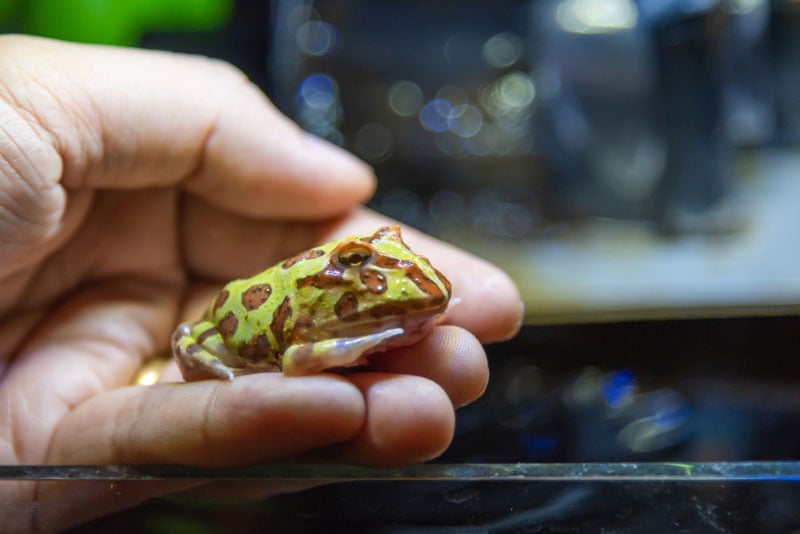
hand holding pacman frog

The South American Horned Frog, also commonly known as the Pacman Frog, is a goofy-looking and surprisingly chilled-out amphibian companion, ideal for first-time reptile or amphibian owners. They don’t have a lot of expensive or special needs, but they do have some unique requirements you should be aware of before setting up your frog’s habitat. Let’s break down exactly what you need to set up the perfect Pacman Frog enclosure, and how to go about it, step-by-step.

Before You Begin

Reptiles and amphibians require more equipment for their initial setup than cats and dogs but are more low maintenance over time. Let’s walk through all the gear you need to get started with your brand-new Pacman Frog today.

You Will Need:

  • 10–20-gallon tank
  • Substrate (coconut coir, soil, moss, etc.)
  • Heat lamp/under-tank heater
  • Thermometer & hygrometer (for measuring temperature & humidity)
  • Wide, shallow water dish
  • Vitamin D3 supplement powder
  • Natural hiding places (rocks, branches, cork, etc.)

The 4 Tips on How to Set Up a Pacman Frog Enclosure

1. Selecting the Right Tank for Your Frog

Male Pacman Frogs do great in a 10-gallon tank, while the larger females may require up to 20 gallons to have enough space. However, it’s worth noting that although Pacman Frogs spend most of their time burrowed in the tank’s substrate, you should still be providing a habitat large enough for them to comfortably move around in. Look for tanks with side doors, as the standard top-opening tanks are hard to clean out and add new substrate to. We also always recommend a lockable door when buying a new tank to keep your frog safe.
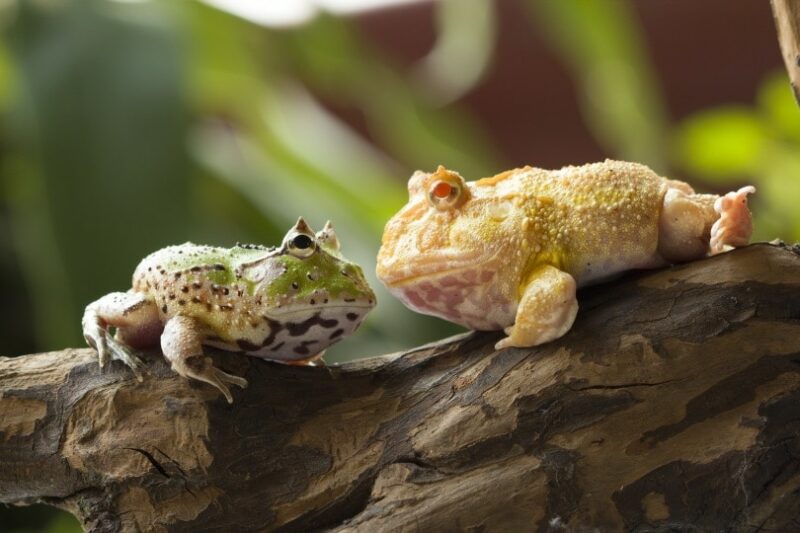
two pacman frog facing each other on a log in the wild
Image Credit by: agus fitriyanto suratno, Shutterstock

2. Choosing Substrate & Adding Hides

Pacman Frogs spend most of their time digging and burrowing in their tank’s substrate, and there are several good options to choose from. Let’s briefly review the most common substrates you can use and a bit about each one.

Pacman Frog Substrates:

  • Coconut coir: New and economical, coco coir, a by-product of harvesting coconuts, holds moisture very well and doesn’t contain any chemicals or pesticides.
  • Potting soil: The classic choice, Pacman Frogs love burrowing in fresh soil, but make sure you choose a sterile mix with no harmful chemicals!
  • Peat moss: Moss is a solid substrate choice but difficult to source in bulk, so we suggest mixing it with another substrate to keep your frog interested.
  • Leaf litter: Partially decomposed leaf matter makes a great alternative to soil that holds moisture very well but needs to be replaced more frequently.

Once you have your chosen substrate, it’s time to spread it all over the bottom of your enclosure. You want to pile it at least 3 inches high so your frog can burrow satisfactorily. This substrate should be sifted every few days and changed weekly to biweekly.

Don’t forget to add live plants, branches, and hides for your frog once you’ve got the substrate in. This allows them to climb or hide at their leisure - making their environment interesting.


3. Light & Temperature Setup

Unlike other reptiles and amphibians, the Pacman Frog doesn’t strictly require a UVB light to stay healthy. You can skip the UVB light if you’re regularly feeding your frog vitamin D3, but you’ll still need a heat lamp. Pacman Frogs prefer temperatures from 75°F to 85°F and need a day/night cycle to regulate their hormones, metabolism, circadian rhythm, and more. Keep an eye on the temperature, and aim for 10–12 hours of fluorescent light per day.

If you’re not feeding your frog vitamin D3, you’ll need a UVB bulb to help your frog synthesize this essential nutrient. It may still be worth looking into supplements considering the time they spend buried, though.

Pacman Frogs love moisture and prefer a humidity range of 60% to 80% in their enclosures. Monitor this by putting a hygrometer on the side inside the tank. You can help maintain this by keeping a shallow dish of clean water for your frog to soak and periodically misting the substrate. Ideally, you want to keep it persistently damp but never totally dry or soaking wet.
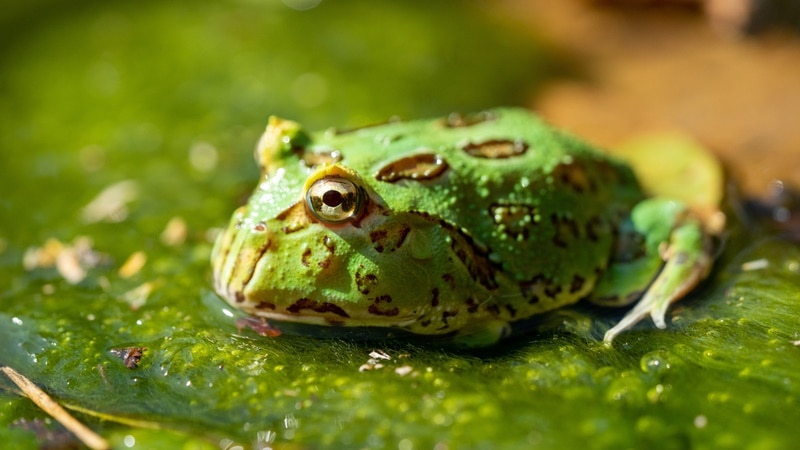
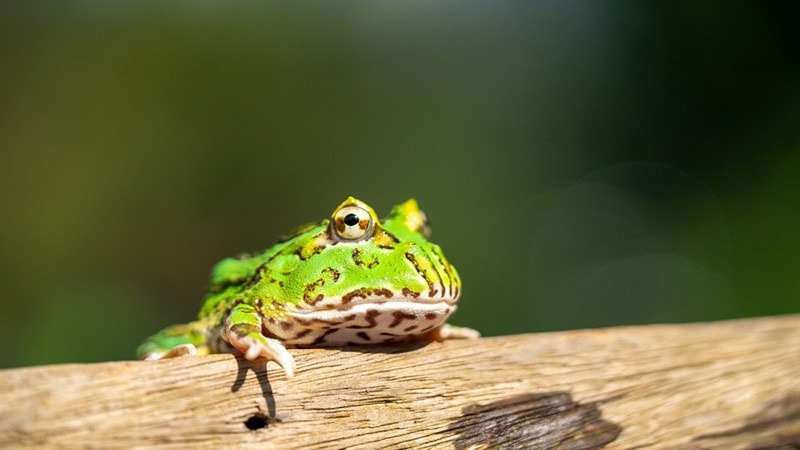
pacman frog resting
Image Credit By: Patchara T, Shutterstock

4. Pacman Frog Diet

Pacman Frogs are voracious eaters with a preference for crickets, dubia roaches, mealworms, minnows, tadpoles, and occasionally, even a whole mouse. Simply put, they’re not picky eaters!

But what about their optimal diet in captivity? Mostly gut-loaded or recently fed crickets frequently swapped out with any of those other offerings above. Dubia roaches are our favorite recommendation because of their very high protein content. Small fish are also healthy choices that can add some variety to the diet—minnows and goldfish are both acceptable.

Final Thoughts

Pacman Frogs have a distinctive look, an ultra-chill personality, and aren’t fussy eaters. The initial setup is a little tricky, requiring you to monitor the temperature and humidity, but we think the Pacman Frog is a perfect choice for anyone who would like to enter the world of amphibian keeping.

Sources

Featured Image Credit: BLUR LIFE 1975, Shutterstock

Get Hepper In Your Inbox

Pet care tips from our vets and experts, straight to your inbox.

List

Select all that apply.

You may opt-out at any time. View our Privacy Policy for more information.

Codee Chessher
Authored by

Codee Chessher

Join the conversation

Ask a question, share your story, or send private feedback.
Rate this post
Required to post. Only our editors see your rating.
Who should see this?

A human reviews every comment before it appears. Your email is never published.

Picked to go with this article

Pacman Frog: Care Guide, Lifespan, Pictures, Diet & More

Pacman Frog: Care Guide, Lifespan, Pictures, Diet & More

Pacman Frogs are a very popular species of pet frogs that get their name from their resemblance to the Pacman computer game character. They are terrestrial fro…

Nicole Cosgrove
By Nicole Cosgrove ·
What Is the Ideal Temperature for a Pacman Frog? Vet Approved Facts & Care Tips

What Is the Ideal Temperature for a Pacman Frog? Vet Approved Facts & Care Tips

You can’t help but smile when you see a Pacman Frog. Its name couldn’t be more appropriate. You may also see it called the Argentinian Horned Frog, which provi…

Chris Dinesen Rogers
By Chris Dinesen Rogers ·
How to Take Care of a Toad: Vet Approved Care Sheet & Guide

How to Take Care of a Toad: Vet Approved Care Sheet & Guide

Toads are fascinating and low-maintenance pets that can provide hours of enjoyment and a unique window into the natural world. However, many people are worried…

Ed Malaker
By Ed Malaker ·
20 Fascinating Pacman Frog Facts for Amphibian Lovers (Vet Verified)

20 Fascinating Pacman Frog Facts for Amphibian Lovers (Vet Verified)

There are thousands of frog species all over the world, each having their own unique qualities. If you are looking for a frog that is suitable for a first-time…

Jordyn Alger
By Jordyn Alger ·

Keep reading

More stories you might like

Pacman Frog Male vs Female: The Differences (With Pictures)

The Pacman frog, or South American Horned frog, is a charming amphibian. They are popular pets due to their unique appearance and engaging behavior, but many p…

Ed Malaker
By Ed Malaker ·
Pacman Frog Male vs Female: The Differences (With Pictures)

Can Pacman Frogs Eat Superworms? Vet-Reviewed Facts & Tips

"Pacman frog" is the common name given to a variety of Horned frogs kept as pets. These frogs have wide mouths and beady eyes, giving them a strong resemblance…

Beth Crane
By Beth Crane ·
Can Pacman Frogs Eat Superworms? Vet-Reviewed Facts & Tips

Do Red-Eyed Tree Frogs Make Good Pets? Read Before You Get One

The Red-Eyed Tree Frog is a unique species that can easily catch the eye due to its unique appearance. While this frog species is native to Central and South A…

Melissa Gunter
By Melissa Gunter ·
Do Red-Eyed Tree Frogs Make Good Pets? Read Before You Get One

North American Toad: Care Sheet, Pictures, Lifespan & More

The North American toad is a remarkable animal. They belong to the genus Anaxyrus, which includes many other species commonly adored as pets (such as the Woodh…

Jordyn Alger
By Jordyn Alger ·
North American Toad: Care Sheet, Pictures, Lifespan & More

African Bullfrog: Care Guide, Diet, Pictures & Lifespan (Vet-Verified Info)

The African Bullfrog (Pyxicephalus adspersus) is a gigantic frog commonly kept in domestic environments. Many keepers love these amphibians because they are in…

Ashley Bates
By Ashley Bates ·
African Bullfrog: Care Guide, Diet, Pictures & Lifespan (Vet-Verified Info)

What to Feed Frogs: 8 Vet-Approved Food Ideas

Frogs are predators and can't survive on prepackaged kibble as your pet dog can. Instead, they mainly live off various insects that you are likely to find in t…

Kerry-Ann Kerr
By Kerry-Ann Kerr ·
What to Feed Frogs: 8 Vet-Approved Food Ideas

American Green Tree Frog: Lifespan, Diet, Pictures & Care Tips

If you’ve heard a frog in your backyard, and you live in the southern states, it was likely an American Green Tree Frog. These cuties of the frog world are not…

Melissa Gunter
By Melissa Gunter ·
American Green Tree Frog: Lifespan, Diet, Pictures & Care Tips

Oriental Fire-Bellied Toad Care Guide: Lifespan, Diet, Pictures & More

The Oriental Fire-Bellied toad is both aptly named and incorrectly named! This fascinating creature is actually a frog rather than a true toad, and the bright…

Beth Crane
By Beth Crane ·
Oriental Fire-Bellied Toad Care Guide: Lifespan, Diet, Pictures & More