Hepper is reader-supported. When you buy via links on our site, we may earn an affiliate commission at no cost to you. Learn more.
Laser Treatment for Dogs: Vet Explained Therapy, Pros, Cons & FAQ

In this article
Laser treatment has been used successfully for decades in human medicine to treat various conditions. In veterinary medicine, this therapy is relatively new but has been utilized in treating pain and inflammation, as well as burns or other injuries.
It's a non-invasive treatment method that does not induce pain or require drugs or surgery. Laser therapy for dogs can be performed as a single treatment or in combination with other treatments, usually painkillers.
In this article, you will learn what laser treatment for dogs is, how it works, what conditions it can improve or treat, how many types of laser therapy there are, and most importantly, if this type of treatment really works.

How Does Laser Treatment Work?
Laser treatment (cold laser therapy or low-level laser therapy) is a type of therapy that uses a very narrow beam of light with different wavelengths depending on the targeted tissues. The term "laser” stands for Light Amplification by Stimulated Emission of Radiation. This type of light penetrates the tissues deeply and promotes a chain of cellular chemical reactions known as photobiomodulation.
Laser therapy for dogs does not cause pain and is non-invasive.
Common treatment for the following conditions:
The laser emission stimulates blood and lymphatic circulation, having positive effects on promoting healing. Secondary to the reduction of inflammation, the pain will also be reduced. There are many human and laboratory studies, alongside anecdotal evidence, on the benefits of using laser therapy in humans, but there is less information available on its use in veterinary patients.
A systematic literature review that looked at papers published between 1980 and 2020 on this topic found a variable degree of bias and limited scientific quality, although there have been some beneficial reports of using laser therapy.1 This makes it hard to form a definitive and critical opinion on this subject, and the true therapeutic value of lasers cannot be fully evaluated at this stage.2
There are, however, studies that have shown the benefits of laser in dogs suffering with osteoarthritis, where it was used as an adjunctive treatment that has reduced joint pain, increasing the dog’s physical activity, and improved their quality of life while reducing the dose of required painkiller medications. When it comes to deciding if your dog may benefit from laser therapy, speak to your vet, who can take into consideration your dog’s individual needs.
Laser therapy for dogs may have the following benefits:
The wavelengths used in veterinary medicine vary depending on the type and depth of the affected tissue. For example, longer wavelengths are used for deep tissues, while short ones are used at the skin level.
The most used laser devices for dogs are those with red or near-infrared light that emit longer wavelengths. Other types of lasers that are used for treating various conditions in dogs are those with violet, green, or blue light.

What Are the Different Types of Laser Treatment for Dogs?
There are four classes of lasers, numbered as follows: 1, 1M, 2, 2M, 3R, 3B, and 4, or I, II, IIIa, IIIb, and IV.3 Lasers are classified according to their power, which is measured in milliwatts (mW). Class I lasers have the lowest power (≤ 0.5 mW), and class IV lasers have the highest power (≥ 500 mW).
In veterinary medicine, class IIIa lasers are mostly used.4 However, some class II and class IV lasers can also be used for therapeutic purposes. Class IV lasers include two types: high-power lasers (≥ 500 mW – surgical and military lasers) and low-power lasers, which can be used for the deep tissues of pets (nerves, ligaments, tendons, joints, and muscles).
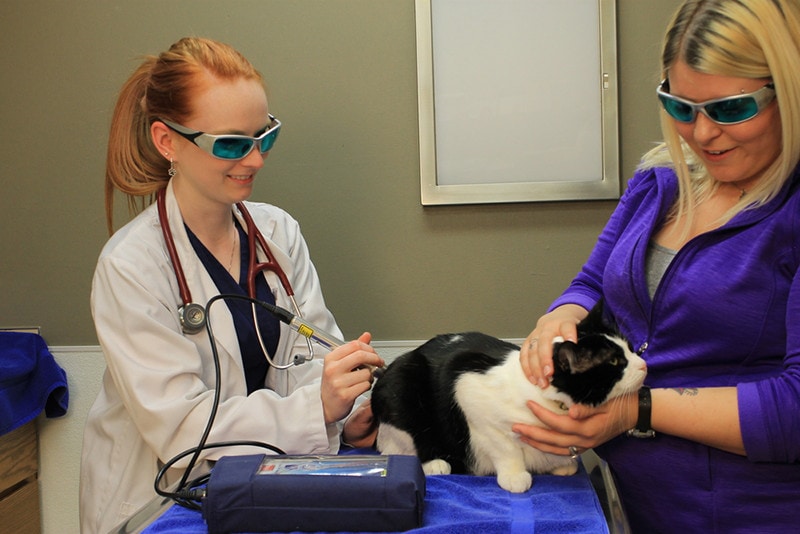
Besides class I and II lasers, all others require eye protection because they can cause retinal burns.
Where Is It Used?
Laser therapy for dogs has many applications in veterinary medicine. It is used successfully in the treatment of pain and inflammation caused by musculoskeletal conditions.
Musculoskeletal conditions treated by laser therapy:
Laser treatment for dogs can also be used successfully in other diseases with different origins.
Other diseases laser therapy can treat:
Although it has rapid effects on inflammation by stimulating blood and lymphatic flow, one session might not be enough for major improvements.
However, there are some contraindications to using laser therapy in pets, and these are generally all types of cancer, including ones on the skin. Using lasers on tumors could cause them to grow more rapidly. Some skin conditions, such as some of the lesions associated with atopic dermatitis, are unlikely to benefit from laser, and this is not a recommended treatment option.

Advantages of Laser Treatment for Dogs
Lasers have been used for decades to treat various conditions. Its first medical application in humans was reported in 1962. Over time, this type of therapy has demonstrated its effectiveness both in humans and pets. In veterinary medicine, laser therapy is used most often in dogs and presents a multitude of potential advantages.
Advantages of laser therapy for dogs:
Disadvantages of Laser Treatment for Dogs
The disadvantages of laser therapy for dogs are very few to non-existent.
Disadvantages of laser therapy for dogs:
How Does a Laser Session Work?
Unlike some cats, dogs will usually not need sedation, but there may be cases where sedation may be necessary.
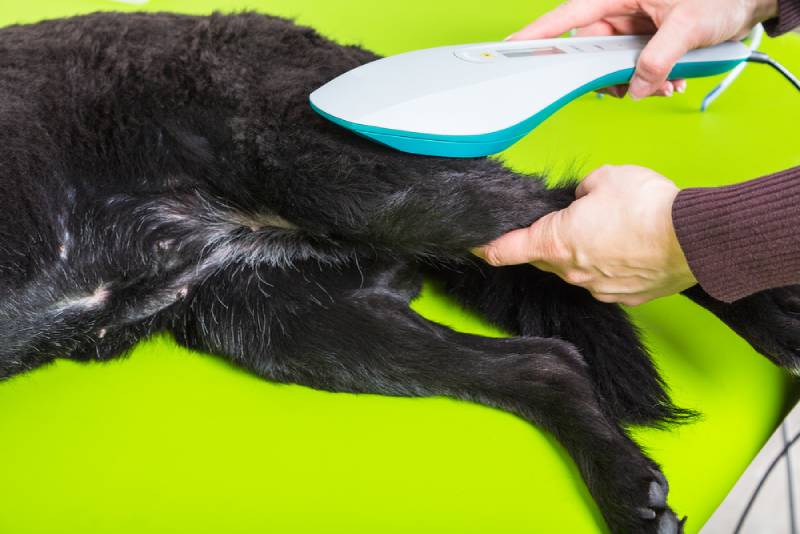
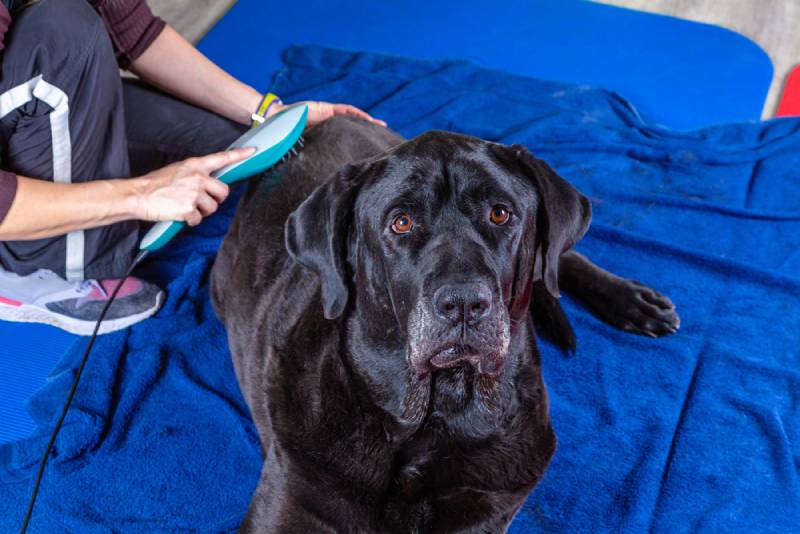
The technician or veterinarian will hold the laser device over the painful or inflamed area of your dog. Depending on the extent of the wounds or the severity of the condition, the treatment can last between 3 and 10 minutes on the area to be treated. In some situations, the laser treatment can last up to 30 minutes.
Most of the time, several sessions are needed to see results, especially in chronic conditions. The number of sessions will be established by the veterinarian depending on the severity of your dog's condition. Usually, acute medical conditions can be resolved in just a few sessions.
In some cases, the vet may recommend laser therapy after surgery to facilitate healing.
How to Recognize Pain in Dogs
The clinical signs of pain in dogs can vary from individual to individual, and many times their owners do not realize their pet is in pain or discomfort unless they show certain signs.
Sometimes behavioral changes that indicate the presence of pain can be too subtle. With the exception of the most severe circumstances (when the signs are obvious), the signs of pain can be "masked" by normal behavior. For example, dogs can wag their tails and be happy to see you even if they are in pain.
Some of the clinical signs of pain may include:
Signs such as lethargy, decreased appetite, changes in breathing, and lack of activity are not specific to pain but may indicate a medical problem your dog has that requires prompt veterinary attention.
Frequently Asked Questions (FAQs)
Can Laser Therapy Help My Dog Walk Again?
Laser therapy for dogs can have positive effects on pets that cannot walk. With appropriate drug treatment and laser therapy, some dogs regained some mobility and function of their legs, even if they were paralyzed.
Laser therapy increases blood flow and helps reduce inflammation and pain, including neuropathic pain and inflammation and swelling associated with spinal injuries. But this is in no way a guarantee that your dog will walk again, as their ability to regain the use of their legs will greatly depend on the type and extent of their injury or condition and whether they require surgical treatment.
How Will My Dog Feel During Laser Treatment?
During a laser therapy session, most dogs relax and may even fall asleep. This therapy is not painful and does not cause tissue damage. In some cases, the treated tissues can slightly warm up, but dogs typically like it and will feel relaxed.

Conclusion
Laser therapy for dogs is a treatment method that does not cause tissue damage or pain and is not toxic to pets. It can be used on its own or in combination with other treatments to promote healing. Laser treatment can also be recommended after a surgical intervention to facilitate tissue healing.
It has many applications in veterinary medicine but is mostly used in musculoskeletal conditions. Laser therapy can also be used for some skin lesions (including burns), postoperative wounds, gingivitis, and more.
Featured Image Credit: msgrafixx, Shutterstock
Get Hepper In Your Inbox


Pet care tips from our vets and experts, straight to your inbox.
You may opt-out at any time. View our Privacy Policy for more information.
Iulia Mihai is a veterinarian with more than 13 years of experience in pet pathology, laboratory, and cancer. She studied at the University of Agronomical Sciences and Veterinary Medicine of Bucharest, Romania Iulia earned a master’s degree in equine and pet pathology and studied epithelial cancer for her Ph.D. Dr. Mihai's passions for internal medicine and parasitology inspired her to volunteer at the faculty’s clinic in her third year of college. She has worked in a couple of veterinary clinics over the years as an internal medicine specialist, and loves to write and educate pet parents about pet nutrition, behavior, and diseases.
Iulia is a passionate veterinarian with a strong affinity for veterinary parasitology, internal medicine, and laboratory. She is excited to share her experience and knowledge with pet owners around the world through her writing and hopes to educate people on pet nutrition, diseases, and behavior.
Education
Iulia graduated from the University of Agronomical Sciences and Veterinary Medicine, Bucharest, Romania, in 2012 and has a Master’s degree in Small Animals and Equines Pathology and is certified in HAACP food safety system implementation. Iulia started her Ph.D. in epithelial cancer in dogs and cats in 2013. Her research is published in national and international veterinary journals.
Experience
Dr. Iulia has been a veterinarian for more than 14 years. She is experienced in animal pathology and laboratory and has experience with exotic animals, such as pet rats and ferrets. She also has skills in the field of clinical pathology, laboratory, microscopy, cancer, and imaging.
Join the conversation
Ask a question, share your story, or send private feedback.