Hepper blog

Search our database of over 9,984 posts with up-to-date information from our experts and veterinarians.

Hepper is reader-supported. When you buy via links on our site, we may earn an affiliate commission at no cost to you. Learn more.

Can Dogs Eat Swiss Chard? Vet Approved Facts & Tips

By Keri-Beth Clur · Reviewed & fact-checked by Dr. Lorna WhittemoreVet Approved
Dr. Lorna Whittemore
Reviewed & Fact-Checked byDr. Lorna WhittemoreVeterinarian
Lorna is a Scottish vet who has lived, studied, and worked on three continents and has a love of travel. With 20 years of experience in small animal medicine andsurgery, both in the charity and private sector. Gaining a further qualification in feline medicine has given her a continued sense of amazement at the fabulous animals. Currently living in Cape Town, South Africa, with her family and expanding number of pets allows her to spend time in and around nature where she is at her happiest. With a love for learning, Lorna is enjoying researching, editing, and fact-checking for Hepper veterinary editorial team and truly feels that she has the best job in the world!View authorThe information is current and up-to-date in accordance with the latest veterinarian research. Read about our vets
Share
Ask us a question in the comments
Can Dogs Eat Swiss Chard

Although Swiss chard isn’t as popular as other vegetables such as pumpkin and kale, it’s full of nutrients, versatile, and has a mild taste. It’s a great addition to quiches, frittatas, stews, and soups, but it can also be eaten raw. The big, green leaves on these vegetables may seem appropriate to feed your dog, but the colorful stalks might make you question whether it’s safe for your dog to eat. We are happy to inform you that yes, Swiss chard is safe for dogs to eat!

Swiss chard is related to other safe-to-eat vegetables, such as spinach and beets, and is rich in vitamins that will benefit your dog. However, it is important to give this snack to your dog in moderation because too much of it can upset their stomach and cause more gas than you may be able to handle.

How Healthy Is Swiss Chard for My Dog?

Your dog should be getting all the nutritional value they need from their dog food, which is why it’s important to feed them a high-quality option that is nutritionally complete and balanced. However, there is nothing wrong with giving them an occasional healthy and low-calorie snack, such as Swiss chard, as long as it isn’t used to substitute certain ingredients in their diet or consumed too frequently.

This vegetable is a snack option to feed overweight dogs because it’s low in calories. Sadly, there is a high percentage of dogs around the world that are overweight or obese and at risk for serious health issues that are often caused by weight problems. This low-calorie snack can be used in training and is a better alternative to commercially produced dog treats. However, a low-calorie snack isn’t the only adjustment your overweight dog will have to accept because exercise is also necessary to shed those unhealthy pounds.

Swiss chard contains a wide array of vitamins and minerals that are greatly beneficial to your dog. We’ve listed them below:

woman sitting on sofa and giving treat to the pembroke welsh corgi dog
Image Credit: LightField Studios, Shutterstock

Vitamins & Minerals in Swiss Chard

  • Fiber: Aids in digestion and produces firm stools. It also makes dogs feel full for longer, which helps with weight loss.
  • Iron: Carries oxygen in the blood and helps with the making of new red blood cells.
  • Vitamin K: Helps the blood to clot, stopping the flow of blood when your dog injures itself.
  • Vitamin A: Supports normal vision and immune function. It also contributes to healthy skin.
  • Vitamin C: Helps reduce inflammation in your dog’s body and supports brain health.
  • Vitamin E: Promotes cell function and a healthy immune system.
  • Magnesium: Helps with the absorption of other minerals and helps with the transfer of energy within your dog’s body.
  • Copper: Helps produce new red blood cells and helps form connective tissue.
  • Manganese: Helps make fatty acids and produce energy.
  • Potassium: Aids in fluid regulation and nerve transmission.
  • Calcium: Maintains the health of bones, teeth, and nervous system.

How To Serve Swiss Chard to Dogs

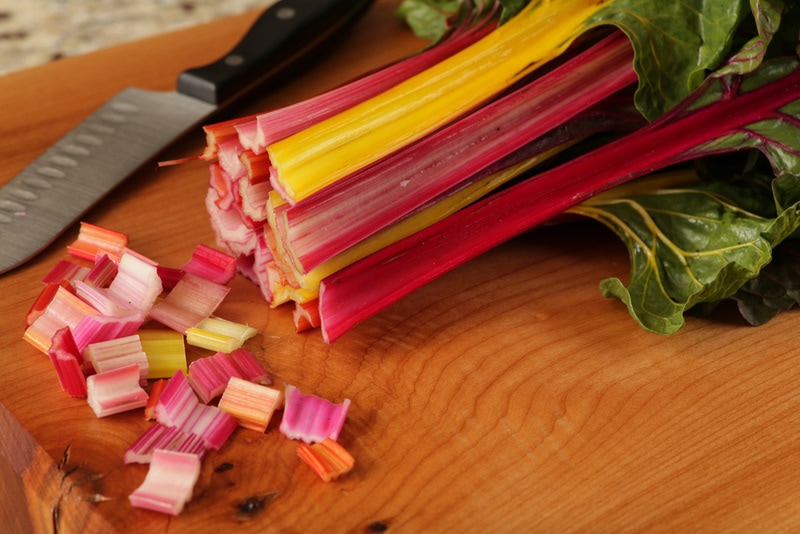
It’s not likely that your dog is going to be the greatest fan of raw Swiss chard due to its bitter taste, so you might want to boil or steam the vegetable to make it more appealing for your dog. You could chop it up into tiny pieces and serve it to your dog mixed into their kibble or another type of dog food, or you can give it to them as is.

The taste isn’t the only reason you should boil Swiss chard before serving it to your dog. The vegetable contains oxalic acid, which, when given in large quantities, can cause issues for their kidneys and may create bladder stones. By boiling Swiss chard, the oxalic acid is reduced. Remember to always wash this vegetable like you would any other to remove any traces of pesticides that may have been sprayed on it, as they can be toxic to your dog.
chopped swiss chard
Image Credit: Ahturner, Shutterstock

When You Should Check with Your Vet

Although Swiss chard is safe for most dogs to consume, you should always check with your vet if they have any health issues, especially if they struggle with food allergies, digestive problems, kidney problems, or anemia.

Your vet will be able to inform you on whether this vegetable could cause issues in your dog or if you can serve it to them without risk. It’s always better to be safe than put your dog in harm’s way.

Conclusion

Swiss chard is a safe and nutritious vegetable that dogs can enjoy in moderation. It contains many vitamins and minerals and is low in calories, suitable for overweight dogs that need an alternative to high-calorie commercial dog treats. For a better taste and to lower the oxalic acid levels this vegetable contains, we recommend boiling it before serving it to your dog.

If your dog has health issues, always check with your vet that the ingredient is safe for them to eat before adding it to their diet.

Sources

Get Hepper In Your Inbox

Pet care tips from our vets and experts, straight to your inbox.

List

Select all that apply.

You may opt-out at any time. View our Privacy Policy for more information.

Keri-Beth Clur
Authored by

Keri-Beth Clur

Join the conversation

Ask a question, share your story, or send private feedback.
Rate this post
Required to post. Only our editors see your rating.
Who should see this?

A human reviews every comment before it appears. Your email is never published.

Picked to go with this article

Can Dogs Eat Spinach? Is Spinach Safe for Dogs?

Can Dogs Eat Spinach? Is Spinach Safe for Dogs?

Popeye makes it clear that eating your fair share of spinach can result in some great health benefits. After all, it is filled with all the natural good stuff…

Nicole Cosgrove
By Nicole Cosgrove ·
Does My Dog Need Vegetables to Stay Healthy? What You Should Know!

Does My Dog Need Vegetables to Stay Healthy? What You Should Know!

It's pretty rare to see a dog crunching on lettuce or getting a carrot stick as a treat. Dogs are known for having voracious appetites, but mostly for protein-…

Nicole Cosgrove
By Nicole Cosgrove ·
Can Dogs Eat Collard Greens? Nutrition & Safety Facts

Can Dogs Eat Collard Greens? Nutrition & Safety Facts

With the rise in healthy eating, many of us find ourselves wondering if our dogs can eat more greens, too. The short answer is, yes, dogs can eat collard green…

Emma Braby
By Emma Braby ·
Can Dogs Eat Artichokes? Vet-Reviewed Benefits, Risks, & FAQs

Can Dogs Eat Artichokes? Vet-Reviewed Benefits, Risks, & FAQs

The artichoke is a popular plant that people love to consume due to its nutritional benefits, including a high fiber content, vitamins, and minerals. Artichoke…

Visnja Radosavljevic
By Visnja Radosavljevic ·

Keep reading

More stories you might like

7 Foods High in Vitamin K for Dogs: Vet Reviewed Advice & FAQ

Vitamin K is a fat-soluble vitamin, meaning it requires bile salts and fats to be absorbed in the gut. It is found mainly in two forms: vitamin K1 (also called…

Genevieve Dugal
By Genevieve Dugal ·
7 Foods High in Vitamin K for Dogs: Vet Reviewed Advice & FAQ

Can Dogs Eat Bok Choy? Vet-Verified Nutrition Facts & Benefits

Bok choy is a common ingredient in Asian cuisine. A member of the cabbage family, bok choy has dark green leaves packed with nutrition. But can dogs eat bok ch…

Nicole Cosgrove
By Nicole Cosgrove ·
Can Dogs Eat Bok Choy? Vet-Verified Nutrition Facts & Benefits

Can Dogs Eat Kale? Vet Approved Facts & FAQ

Kale is a nutrient-rich leafy green vegetable that has become increasingly popular in recent years. While it can be a great addition to many human diets, some…

Nicole Cosgrove
By Nicole Cosgrove ·
Can Dogs Eat Kale? Vet Approved Facts & FAQ

Can Dogs Eat Chayote? What The Science Says!

Chayote is a vegetable native to Mexico and Central America that is gaining popularity in the U.S. due to its many health benefits—for humans. It has a long hi…

Nicole Cosgrove
By Nicole Cosgrove ·
Can Dogs Eat Chayote? What The Science Says!

Can Dogs Eat Rutabagas? Keep Your Dog Safe!

There are several ingredients in dog food formulas these days, and it can be difficult to know which food items are good or bad for our dogs. For instance, som…

Jordyn Alger
By Jordyn Alger ·
Can Dogs Eat Rutabagas? Keep Your Dog Safe!

Can Dogs Eat Radishes? Vet-Reviewed Facts & Suggestions

Some dog owners prefer to feed strictly kibble diets, while others swear by home-cooked meals with fish and meat. In any case, to keep our furry buds well-fed…

Nicole Cosgrove
By Nicole Cosgrove ·
Can Dogs Eat Radishes? Vet-Reviewed Facts & Suggestions

Can Dogs Eat Spring Mix? Vet-Reviewed Benefits & Precautions

Ever found your pup staring up at you with adoring eyes as you prepare yourself a bowl of salad? Like us, dogs are curious creatures who love exploring new tas…

Cheryl Regan
By Cheryl Regan ·
Can Dogs Eat Spring Mix? Vet-Reviewed Benefits & Precautions

Can Dogs Eat Basil? Vet-Verified Nutrition Facts, Tips & Alternatives

If you enjoy cooking at home, you’re probably familiar with basil, a fragrant and versatile herb used in many Italian and Asian recipes. Dog owners might wonde…

Elizabeth Gray
By Elizabeth Gray ·
Can Dogs Eat Basil? Vet-Verified Nutrition Facts, Tips & Alternatives