Hepper is reader-supported. When you buy via links on our site, we may earn an affiliate commission at no cost to you. Learn more.
Green Discharge From a Pregnant Dog: Signs, Causes & Care (Vet Answer)

In this article
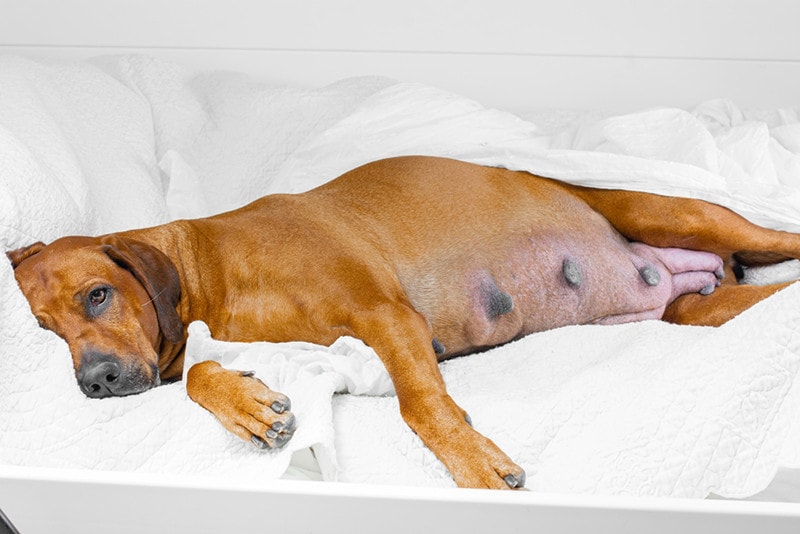
If you have decided to take the leap into breeding your dog, you may think that you’re prepared for anything. Then, just as things start to get interesting and it’s looking like puppies will soon be appearing, you see green discharge appearing from your dog’s vulva. Should you panic?
Surprisingly, the answer is no, but it is a sign that you should be seeing puppies very soon.
In the following article, we’re going to talk about what is and isn’t normal when it comes to whelping, what to expect, and when to call the vet.

What Are the Signs of Whelping?
The canine gestation period is around 63 days, give or take a day or two. By around day 50, you should be getting everything in place in preparation for the impending arrivals, including a checkup with the vet, adding calories and calcium-rich food into your dog’s diet, preparing a suitable whelping box, and brushing up on what to expect when it comes time for the puppies to be born.
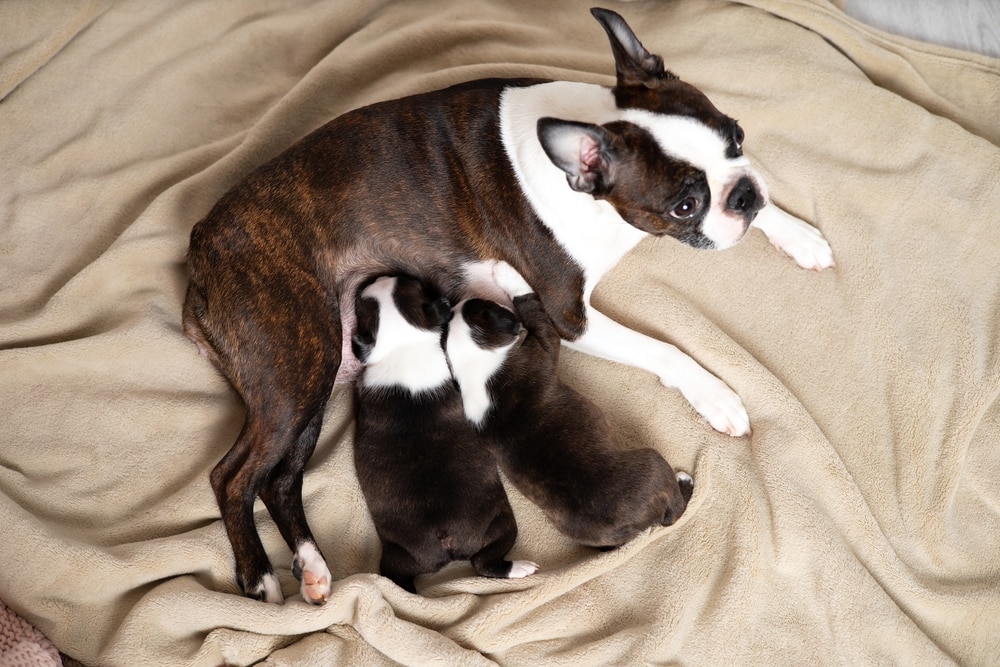
There are three stages of whelping. Although, in dogs, stages two and three tend to happen simultaneously with each pup.
Stage one can be as short as an hour or two, or last half a day. Once she has entered stage two, you should expect to see the first pup within 1–2 hours, with no more than 30–60 minutes between each pup. However, if it is a difficult and tiring delivery, some dogs will revert back to stage one for a period of time to rest.

Why Is the Discharge Green?
Inside the placenta, the pups have been receiving nutrition from their mother through the umbilical cord, and when they are close to being born, their digestive system starts to function. The unborn pups will excrete waste products, which are green, due to the breakdown of red blood cells and bilirubin.
The fluid is usually a mixture of clear mucus, some blood, and this waste material which can be either a bright or dark green.
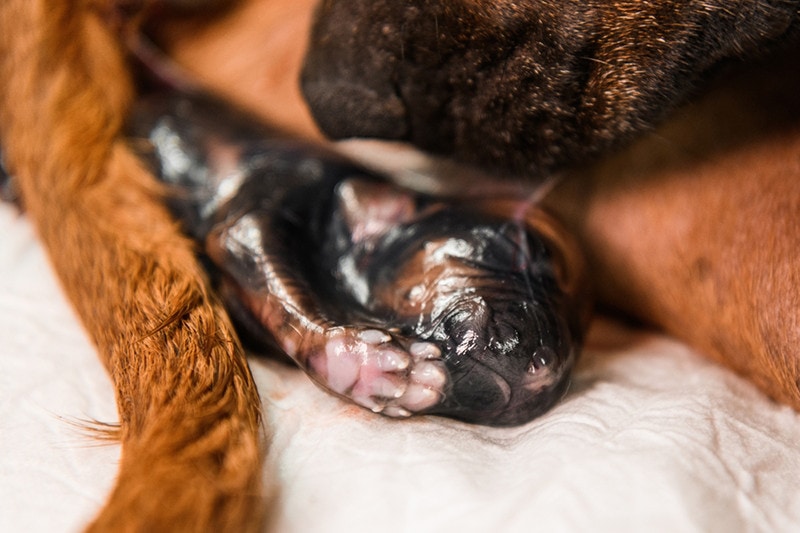
If the placenta ruptures during delivery, that green fluid will appear as a vaginal discharge. In the majority of cases, green discharge means that the puppy is in the vaginal canal and only seconds away. Although this is a perfectly normal thing to see, if a puppy is not born within 10–15 minutes of this sort of discharge appearing, it is time to call the vet.
Green discharge can either mean that there is a tear in the placental sac, or that the puppy has completely separated from the placenta. The second situation becomes an emergency if the pup is not delivered quickly, as it will no longer be able to receive oxygen via the umbilical cord.
What Sort of Discharge Is Not Normal?
Although green-colored vaginal discharge is quite normal during whelping, there are a number of discharge types that can indicate that there is a problem with the delivery (dystocia) and that you must call your vet immediately.

What if There Is No Discharge?
While it is normal to see vaginal discharge before, during, and for several days after whelping, what if there is no discharge at all? To answer this question, we need to ask a few more:
Is She Definitely Pregnant?
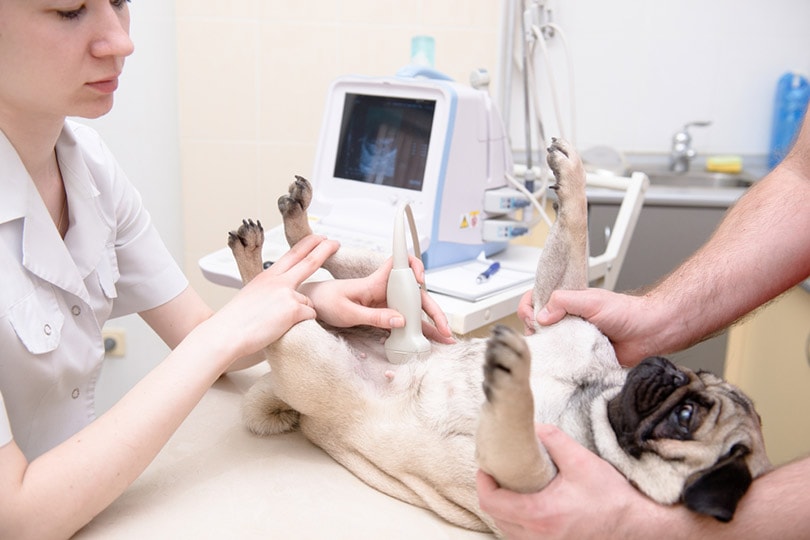
Dogs can have false or phantom pregnancies after they have mated, or even if they haven’t! Their hormones tell their body to prepare for the arrival of puppies, so you may see her nipples getting swollen, and she may even start nesting. It is always a good idea to have a pregnancy scan at the vet’s office at around day 35 to check that your dog is pregnant.
Has She Started Whelping, or Is She Just Due?
Once your dog enters stage one of labor, you should expect to see some discharge, even if it is only a small amount. Because fertilization of the egg can occur 3–5 days after mating, there can be quite a window of time for the actual delivery, so if she is not showing any other signs of whelping, we probably just need to wait a little longer.
Is She Licking a Lot “Down There”?
A lot of dogs are fastidious about keeping clean, so it may just be that she is cleaning up any discharge before you can spot it!
Is She Actively Straining and Having Contractions?
If she appears to have entered stage two and you are not seeing any signs of puppies or discharge, it is time to call your vet. If a pup is in the wrong position or too large to enter the vaginal canal, a cesarean may be needed to safely deliver the pups.
Conclusion
When it comes to whelping, there are almost as many colors of vaginal discharge as there are shades of gray. Some colors are normal, whereas others are definite causes for concern.
In the case of green discharge, this is quite a normal thing to see, but if your dog has not delivered a puppy within 10–15 minutes, you should seek veterinary advice. It might be useful to remember that, when it comes to whelping, green means go!
Whelping can be an exciting and stressful time, both for you and your dog. It is important to give your dog space to deliver her pups, but it is also important to keep an eye on things to make sure everything is proceeding as it should.
Speak to your vet to make sure you have a plan in place in case things go wrong, and make sure you have emergency contact numbers as well. If in doubt, it is better to phone your vet for advice, as waiting can put your dog and her pups at risk. Gathering as much information as you can from articles like this is a great way to ensure you are as prepared as you can possibly be and know what to expect.
See also:
Sources
Featured Image Credit: Nina Buday, Shutterstock
Get Hepper In Your Inbox


Pet care tips from our vets and experts, straight to your inbox.
You may opt-out at any time. View our Privacy Policy for more information.
Karyn has lived in the UK for the past 10 years after moving from Queensland, Australia. In 2010, she graduated from The University of Queensland School of Veterinary Science, and also holds a Bachelor’s degree in Zoology. Karyn is passionate about using evidence, experience, and owner collaboration to provide the best solutions for pets, and believes in making reliable information about animal health accessible to all. She shares her home with 5 cats, 4 dogs, and 1 husband, and when she is not practising as a veterinary surgeon, she spends her time writing, gardening, and cleaning up pet hair!
Karyn comes from Queensland, Australia, but has lived in the UK for the past 10 years. She is passionate about using evidence, experience, and owner collaboration to provide the best solutions for pets, and believes in making reliable information about animal health accessible to all.
She shares her home with 5 cats, 4 dogs and 1 husband, and when she is not practising as a veterinary surgeon, she spends her time writing, gardening, and cleaning up pet hair!
Education
In 2010, Karyn graduated from The University of Queensland School of Veterinary Science and also holds a Bachelor’s degree in Zoology.
Experience
Dr. Kanowski has worked in small animal practice, both in Australia and the UK, and she will be very happy if she never has to see another post-Brexit Animal Export Certificate again! Karyn has special interests in acupuncture and canine behavior and loves challenging surgical cases.
Join the conversation
Ask a question, share your story, or send private feedback.