Hepper is reader-supported. When you buy via links on our site, we may earn an affiliate commission at no cost to you. Learn more.
Can Bearded Dragons Eat Arugula? Vet-Reviewed Nutrition Facts & FAQ


In this article
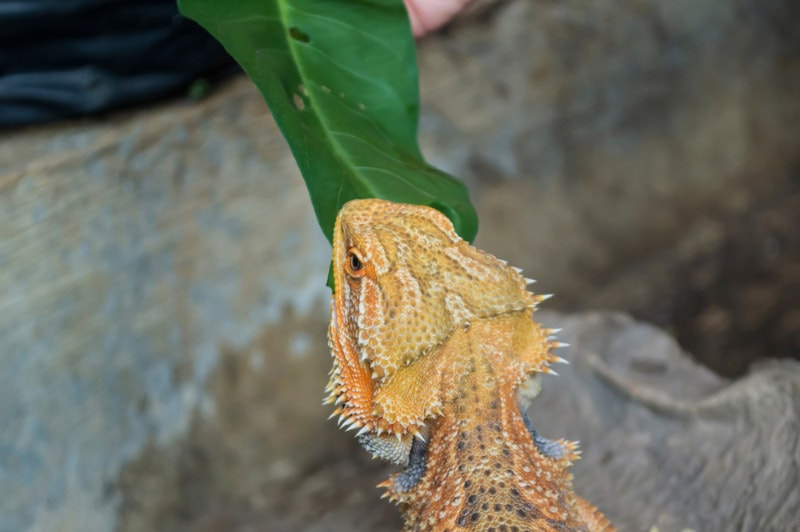
Bearded dragons are omnivores that need a daily salad to stay happy and healthy. A mixture of staple greens is necessary to meet your beardie’s nutritional needs. One of the best staples you can offer your pet is arugula. Read on to learn more about this highly nutritious veggie and its benefits for your bearded dragon.

What Is Arugula & Its Nutritional Benefits?
Arugula is a peppery and slightly tart leafy green, also known as Rocket. It has a bit of a spicy and nutty taste, which some beardies develop a taste for right away. Not all arugula is equal, however. Most experts recommend baby arugula over other varieties as it’s softer and more flavorful. Arugula provides a fantastic source of antioxidants, fiber, calcium, and vitamins A, C, and K.
Beardies need vitamin A for immune system function, bone growth, and secretory gland function, and fiber is essential for reptiles as a bulking agent and to boost gut motility. There is no clear evidence that reptiles need to consume Vitamin C through their diet, though it can be beneficial to the recovery process of certain diseases. Vitamin K is an essential nutrient for your beardie’s health, as it plays a role in calcium and phosphorus metabolism in bone.
Perhaps the biggest benefit of using arugula as a staple veggie is its fantastic calcium-to-phosphorus ratio of 3:1.

What’s the Deal With Calcium-to-Phosphorus Ratio?
If you’ve been educating yourself about bearded dragon nutrition, you’ve likely read about the importance of an optimal calcium-to-phosphorus ratio (Ca:P).
Many beardies develop preventable diseases because they aren’t being provided with proper amounts of calcium, phosphorus, and vitamin D3.
As with humans, calcium performs various essential body functions in your reptile. Lizards on low-calcium diets can develop hypocalcemia, which stimulates increased production of the parathyroid hormone. This will then mobilize calcium from the bones, which may eventually result in the loss of bone mass and weaker bones. This can cause metabolic bone disease (MBD), a common, debilitating, and painful disease that is entirely preventable.
Beardies need vitamin D3 as it is essential in metabolizing and absorbing calcium and phosphorus. Your pet’s body cannot use its calcium if it isn’t also receiving vitamin D3.
The ideal calcium-to-phosphorus ratio should be greater than two to one. With a 3:1 ratio, you can see that arugula is a fantastic veggie to use as a staple.
How to Offer Arugula to Your Bearded Dragon
Preparing arugula for your beardie’s salad is very easy.
Wash the arugula to remove any lingering insecticides or pesticides that were used during the growing period. Next, remove the long portion of the stems that may be difficult for your beardie to chew through. This may be less of an issue with baby arugula, as its stems are generally softer. Finally, cut the arugula down into manageable pieces. As with your pet’s insects, the food it eats should be no larger than the space between its eyes.
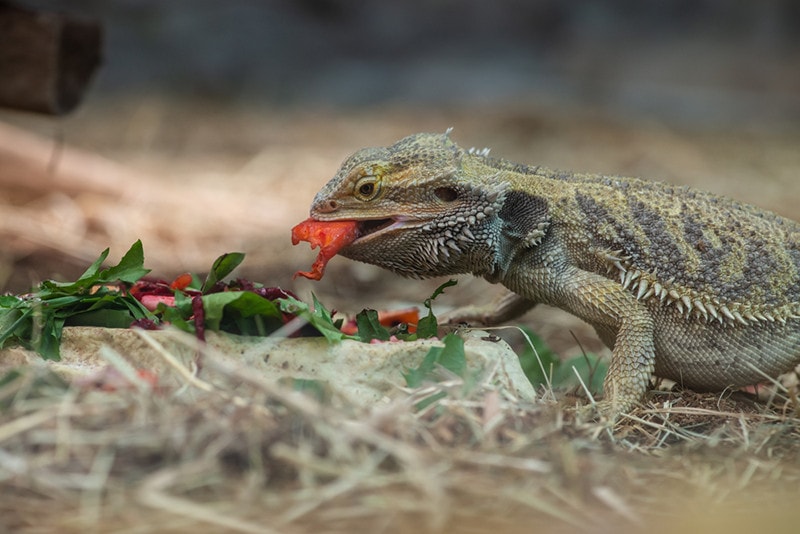
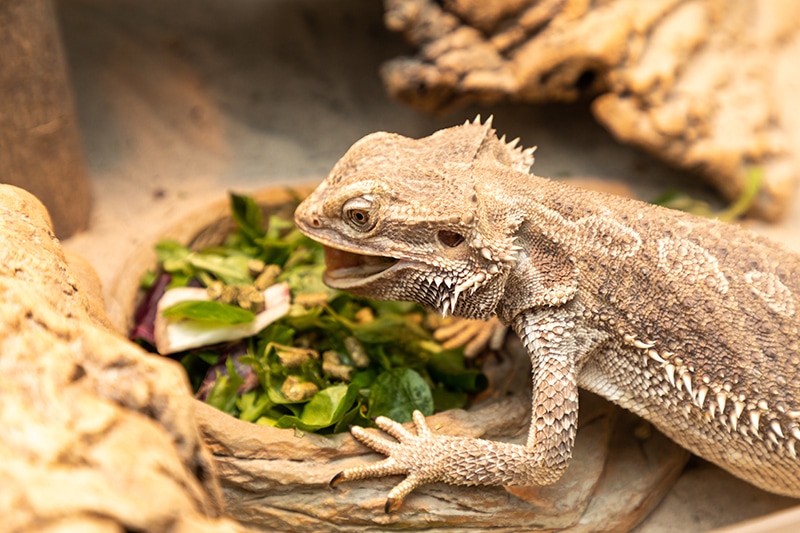
Add the arugula to your beardie’s salad bowl alongside other staples and healthy vegetables.
What Other Veggies Should Be in My Beardie’s Salad?
The more staple veggies in your beardie’s daily salad, the better. Remember to consider the calcium-to-phosphorus ratio when choosing which ones to include.
The following vegetables are great to offer daily (we’ve included the Ca:P ratio in brackets):
- Cactus pads (2.3:1)
- Collard greens (14.5:1)
- Dandelion leaves (2.8:1)
- Mustard greens (2.4:1)
- Turnip greens (4.5:1)
You can add the following vegetables occasionally to add some variety to your beardie’s salad. They are suitable to feed in smaller amounts, but due to other compounds (e.g., phosphorus, oxalates, etc.), they should not form part of their primary diet:
- Bok choy (2.8:1) – goitrogenic
- Cilantro (1.4:1) – higher in oxalates
- Green cabbage (2:1) – goitrogenic
- Pea sprouts (1:4.6) – high in phosphorus
- Watercress (2:1) – higher in oxalates
Other occasional mix-ins include:
- Bell peppers
- Carrots (grated and raw)
- Carrot greens
- Cucumbers (peeled)
- Pansies
- Parsley
- Spinach
- Squash (raw)
- Sugar snap peas
- Zucchini
Final Thoughts
Arugula is a fantastic staple veggie to include in your bearded dragon’s daily salad. However, don’t rely solely on arugula’s powerful nutritional punch to provide your pet with all the nutrients it needs. Mix several staple veggies in a single salad and add variety by providing other veggies (and occasionally fruit).
Related Reads:
Can Bearded Dragons Eat Grass? Vet-Approved Facts, Diet, & Risks
Can Bearded Dragons Eat Oregano? Vet-Reviewed Nutrition Facts & FAQ
Sources
Featured Image Credit: Sea Wave, Shutterstock
Get Hepper In Your Inbox


Pet care tips from our vets and experts, straight to your inbox.
You may opt-out at any time. View our Privacy Policy for more information.
Chantelle's life revolves around two passions: writing and animals. Raised on the prairies of Canada amidst a menagerie of pets, she now lives with five cats, two guinea pigs, and a bearded dragon. Together with her husband and child, Chantelle delights in being an exemplary animal parent, going as far as installing wall-mounted cat shelves to give their cats an indoor playground. When she's not cozying up with her cats or snapping their amusing antics, she enjoys venturing into the Rocky Mountains, binge-watching her favorite Netflix shows, and indulging in spontaneous reading adventures.
Join the conversation
Ask a question, share your story, or send private feedback.