Hepper blog

Search our database of over 9,984 posts with up-to-date information from our experts and veterinarians.

Hepper is reader-supported. When you buy via links on our site, we may earn an affiliate commission at no cost to you. Learn more.

Do Frogs Have Bones? Vet-Approved Anatomy Facts

By Krysha Thayer · Reviewed & fact-checked by Dr. Luqman JavedVet Approved
Dr. Luqman Javed
Reviewed & Fact-Checked byDr. Luqman JavedDVM (Veterinarian)
Dr. Luqman grew up with an extreme fondness for animals and turned a childhood dream into reality by becoming a veterinarian. His goals are now focused on helping pet owners understand their pets better in order to ensure the best quality of life for all pets globally. He is passionate about wildlife, exotic pets, pet owner education, and animal welfare. Luqman has 3 years of professional experience working with a variety of animal species. He has skills in demonstrating proper animal husbandry and training some exotic species, such as parrots. Additionally, he has decades of personal experience with keeping many exotic pets: freshwater fish, parrots, songbirds, chickens, ducks, turtles, and hamsters.View authorThe information is current and up-to-date in accordance with the latest veterinarian research. Read about our vets
Share
Ask us a question in the comments
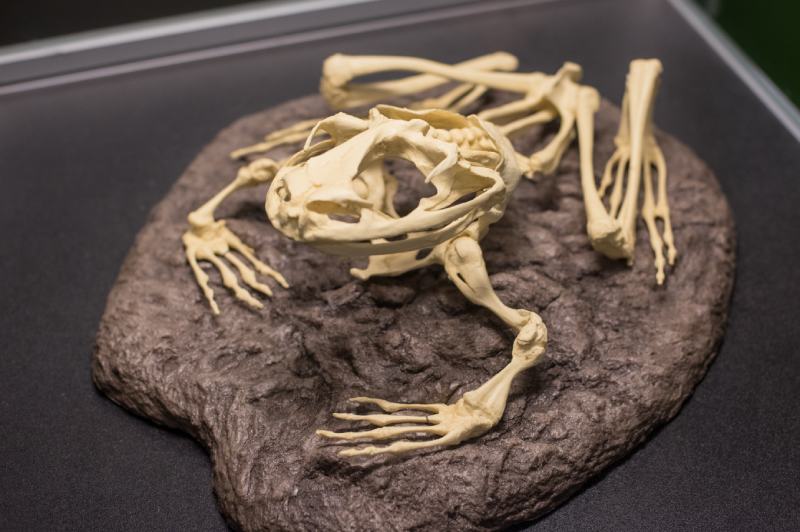
Close up of a frog amphibian skeleton on brown stone in a museum

While it may not look like it, frogs do indeed have bones. They are vertebrates, just like humans, who have an internal skeletal structure. In fact, just like humans, they have many of the same features, like a skull, backbone, hips, limbs, and digits.

However, frogs have adapted to their unique environment and abilities with a skeleton that’s just as unique as their vocalizations.

Frog Bones Are Specialized

It takes a lot of muscle to jump, swim, and climb, but a frog’s skeletal system plays just as important a role in helping accomplish these activities. Depending on the species, their bones may be regular in a microscopic aspect, while other frogs have bones that show signs of hyperossification (excessive thickening).
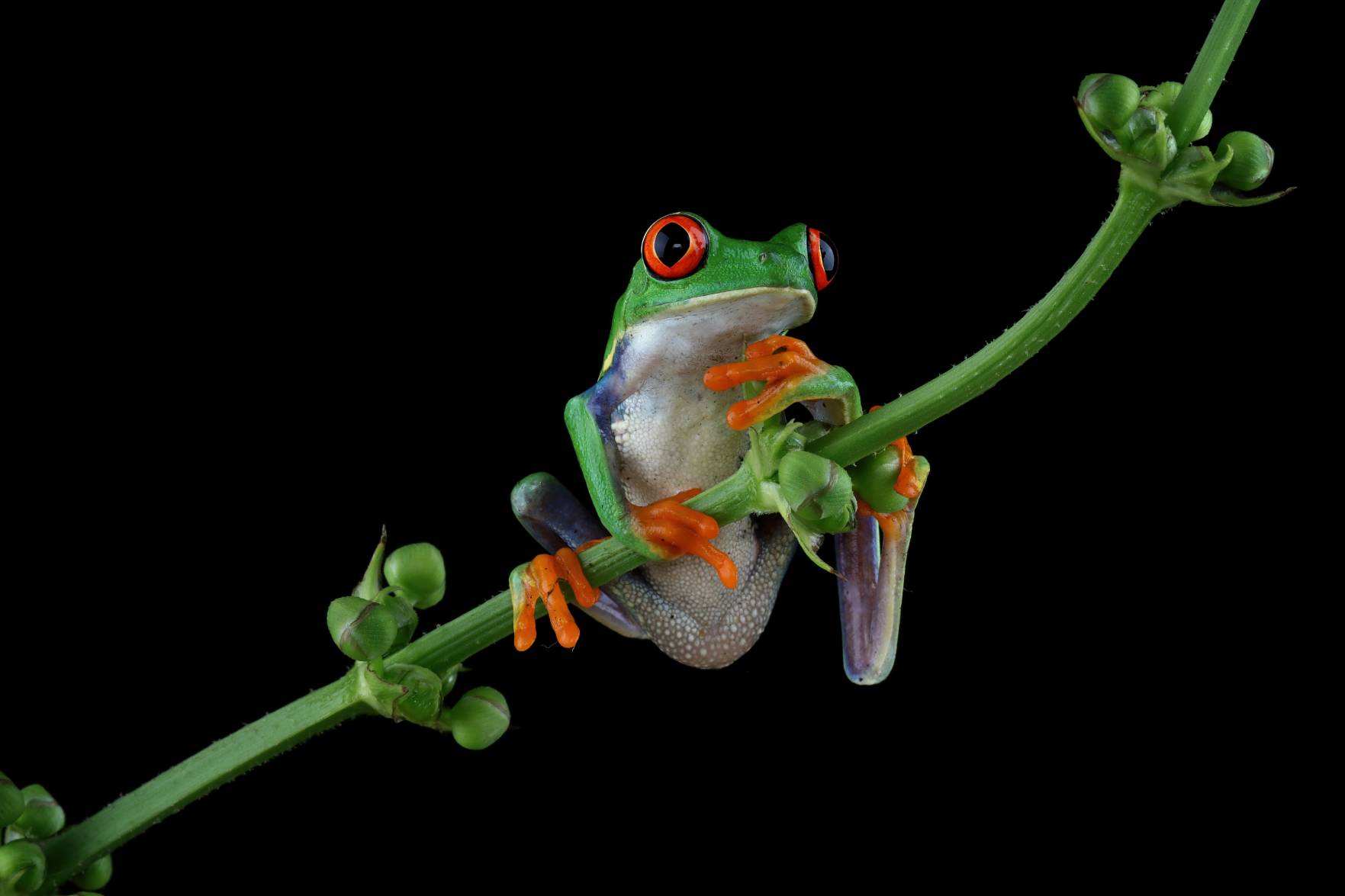
Red-eyed Monkey Frog
Image By: Kurit afshen, Shutterstock

Frogs Have a Lot of Extra Joints

The extra joints in their legs allow them to fold them in as close as possible to their body, making them smaller and less likely to be seen by prey. It also allows them to wrap their legs around objects like rocks and plants or trees. Their legs have thick muscles to support these extra joints. The extra joints in their arms allow them to “hug” objects, and the ones in their feet and hands allow them to grip tightly.

Frogs Have Five Toes

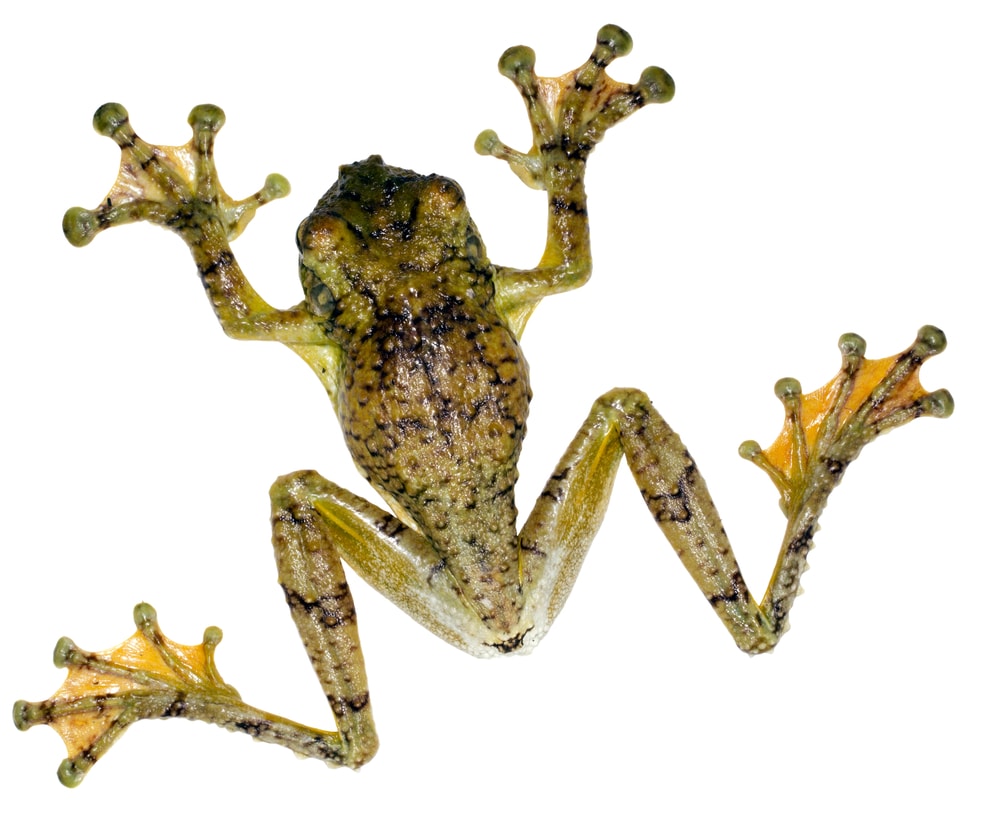
Frogs have four fingers on their front limbs and five toes on their back feet. All of their digits (fingers and toes) have very long bones with a lot of joints, enabling them to swim fast while in the water and giving them the ability to grip surfaces more easily. Bigger feet also enable them to push off from the ground with more force when jumping.
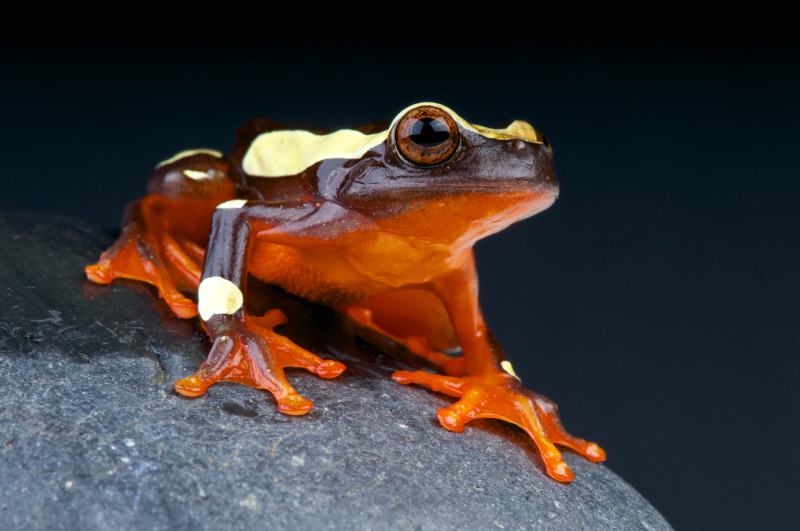
Clown Tree Frog Dendropsophus leucophyllatus on stone
Image Credit: reptiles4all, Shutterstock

Frogs Have Very Short Backbones

Frogs only have nine vertebrae (though some species have 10). They are arched with no ribs and connect to very wide hip bones. Frogs don’t have “true joints” between the spinal vertebrae. Their embryonic development produces vertebrae that appear to be hollowed out on the front and at the back or on one side only. The entire backbone serves to protect the spinal cord.

Frogs Don’t Have Ribs

Frogs don’t have ribs, so they breathe differently than humans do. In order to draw air into their body, frogs lower the floor of their mouth, which causes the throat to expand. Then the nostrils open, enabling air to enter the enlarged mouth. The nostrils then close, and the air in the mouth is forced into the lungs by contraction of the mouth’s floor. To eliminate the carbon dioxide in the lungs, the floor of the mouth moves down, drawing the air out of the lungs and into the mouth. Finally, the nostrils are opened, and the floor of the mouth moves up, pushing the air out of the nostrils. Frogs also breathe through the skin.
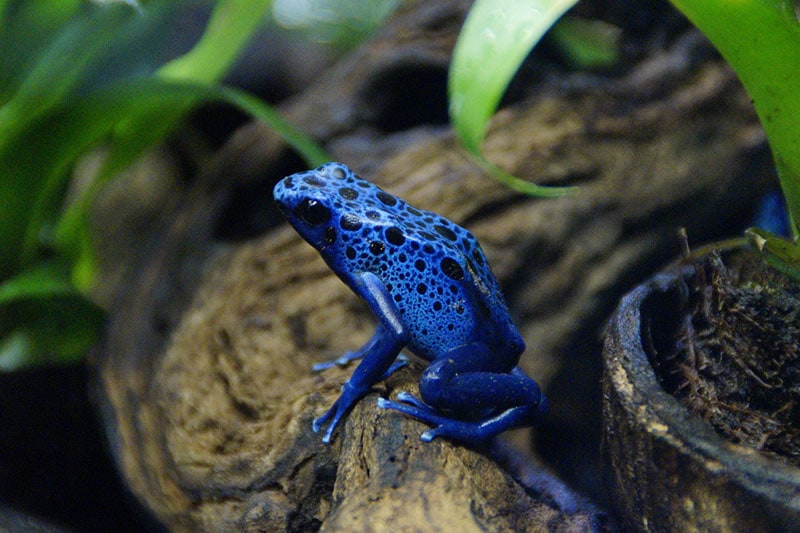
a blue poison dart frog on a tree
Image By: Efraimstochter, Pixabay

Frogs Have a “Urostyle” Tailbone

At the end of their short backbone, frogs have a urostyle, which is a long, thin bone. It plays a major role in transmitting thrust from the hind limbs to the frog’s back during limb-driven locomotion or jumps.

Summary

It is true that frogs have bones. In fact, as amphibians that jump, swim, and climb, their bones are quite unique. They have evolved over many centuries into the frogs we see today, with internal skeletons adapted to their environment.

See Also:

Sources

Featured Image Credit: Ian Dikhtiar, Shutterstock

Get Hepper In Your Inbox

Pet care tips from our vets and experts, straight to your inbox.

List

Select all that apply.

You may opt-out at any time. View our Privacy Policy for more information.

Krysha Thayer
Authored by

Krysha Thayer

Join the conversation

Ask a question, share your story, or send private feedback.
Rate this post
Required to post. Only our editors see your rating.
Who should see this?

A human reviews every comment before it appears. Your email is never published.

Picked to go with this article

Do Frogs Have Backbones? Vet-Approved Anatomy Explanation

Do Frogs Have Backbones? Vet-Approved Anatomy Explanation

While animals fall into many different classifications, you can more broadly classify them as either vertebrates or invertebrates with vertebrates being animal…

Lindsey Lawson
By Lindsey Lawson ·
How Many Toes Do Frogs Have? Vet-Verified Anatomical Information

How Many Toes Do Frogs Have? Vet-Verified Anatomical Information

Some swear it’s four, others swear it’s five–but exactly how many toes does a frog have? Frogs have 18 toes in total: five toes on each hind leg, equaling 10 t…

Nicole Cosgrove
By Nicole Cosgrove ·
Can Frogs Breathe Underwater? Vet Approved Facts & FAQ

Can Frogs Breathe Underwater? Vet Approved Facts & FAQ

Frogs are amazing creatures considering their minuscule size. They are one of the few animals that start life as one type of creature, a tadpole, and then chan…

Gregory Iacono
By Gregory Iacono ·
Frog vs Toad: Vet-Reviewed Differences (With Pictures)

Frog vs Toad: Vet-Reviewed Differences (With Pictures)

At a glance, toads and frogs seem indistinguishable from one another in terms of the sort of animal that they are. As with many types of animals, there is stun…

Eleanor Glaum
By Eleanor Glaum ·

Keep reading

More stories you might like

Are Frogs Reptiles? Vet-Approved Facts & Care Tips

Many of us grew up learning about frogs’ amazing transformation from tadpoles to adults in science class. But does the unique biology and life cycle of these c…

Nicole Cosgrove
By Nicole Cosgrove ·
Are Frogs Reptiles? Vet-Approved Facts & Care Tips

Is a Frog a Mammal? Vet-Verified Facts & Explanation

In the world of vertebrates (animals with backbones), there are five main groups, which are mammals, reptiles, birds, fish, and amphibians. It can sometimes be…

Kit Copson
By Kit Copson ·
Is a Frog a Mammal? Vet-Verified Facts & Explanation

Do Frogs Drink Water? Frog Hydration Explained

There are over 6,000 different species of frogs found in various kinds of habitats. Some frogs spend most of their lives living in water, while other frogs, li…

Jessica Kim
By Jessica Kim ·
Do Frogs Drink Water? Frog Hydration Explained

Is a Toad an Amphibian? Vet-Reviewed Facts & FAQ

Toads are amazing creatures that you can find almost anywhere. They're highly adaptable and possess many unique traits. One thing that many people might wonder…

Ed Malaker
By Ed Malaker ·
Is a Toad an Amphibian? Vet-Reviewed Facts & FAQ

How High Can Frogs Jump? Science-Based Facts & FAQ

In the animal kingdom, there are creatures of all kinds that can do amazing things. Bats hunt food using echolocation, eagles can spot prey from hundreds of ya…

Nicole Cosgrove
By Nicole Cosgrove ·
How High Can Frogs Jump? Science-Based Facts & FAQ

Can Frogs Fart? Vet-Verified Causes & Facts

When it comes to flatulence, we know that our dogs and fellow humans can clear a room. But what about frogs? These interesting amphibians have quite a differen…

Ashley Bates
By Ashley Bates ·
Can Frogs Fart? Vet-Verified Causes & Facts

Do Frogs Have Hair? Amphibian Anatomy & Vet Approved Facts

We brush and bathe our pets, as it is essential to take good care of their hair for their comfort and health. But if you're interested in amphibians, specifica…

Kathryn Copeland
By Kathryn Copeland ·
Do Frogs Have Hair? Amphibian Anatomy & Vet Approved Facts

16 Facts About Toads: Appearance, Origin, Singing & More

Toads don’t get much love from mass media, cartoons, or fairytale books. They’re mostly pictured as evil, demonic creatures that bring misfortune into the worl…

Nicole Cosgrove
By Nicole Cosgrove ·
16 Facts About Toads: Appearance, Origin, Singing & More